How to Decode a VIN Number: Complete 2026 Guide | VinSpectorAI
Every vehicle has a 17-character code hiding in plain sight — on the dashboard, the door jamb, the title. Most owners never look past it. But that code, the VIN, encodes the exact factory configuration of the vehicle: engine, transmission, trim, plant, and production sequence. Here's how to actually read it, and why it matters more than most buyers realize.
What Is a VIN and Why Does It Matter?
A Vehicle Identification Number (VIN) is a unique 17-character code assigned to every car, truck, motorcycle, and most powersports vehicles manufactured since 1981. No two vehicles share the same VIN — it functions as a fingerprint, used by manufacturers, insurers, DMVs, and law enforcement to track a vehicle's identity, specifications, and history throughout its life.
For buyers, decoding a VIN matters because the sticker on a used car — "loaded," "sport package," "tow package" — isn't always accurate. Sellers misremember trims, dealers copy-paste generic descriptions, and private listings sometimes describe what a car should have rather than what it actually left the factory with. The VIN doesn't have that problem. It reflects the vehicle's actual build, and it doesn't change no matter who's selling it or how the listing is worded.
VINs also matter for reasons that have nothing to do with trim levels. Recalls, registration, insurance quotes, and financing all key off the VIN. A single mistyped character can pull up the wrong vehicle's data entirely, which is one reason understanding the structure — not just plugging numbers into a website — is worth a few minutes of your time.
A Brief History: Why 17 Characters?
Before 1981, VIN formats varied by manufacturer and sometimes by model year, which made cross-referencing vehicles difficult for regulators and insurers. The National Highway Traffic Safety Administration standardized the format in 1981, requiring all vehicles sold in the US to use a consistent 17-character VIN following the ISO 3779 international standard. This is why decoding tools and guides — including this one — generally apply cleanly to anything built from 1981 onward, while older vehicles may use shorter or inconsistent numbering that doesn't follow the same rules.
The Structure of a VIN: WMI, VDS, VIS
Every 17-character VIN breaks into three sections, each with a specific job.
Position | Section | What It Represents | Example |
|---|---|---|---|
1–3 | WMI (World Manufacturer Identifier) | Manufacturer and country of origin | 1FA = Ford, USA |
4–8 | VDS (Vehicle Descriptor Section) | Model, body type, engine, restraint system | Varies by manufacturer |
9 | Check Digit | Mathematically validates the VIN is authentic | 0–9 or X |
10 | Model Year | Encoded letter or number for the year | L = 2020, M = 2021 |
11 | Plant Code | Factory where the vehicle was assembled | Manufacturer-specific |
12–17 | VIS (Vehicle Identifier Section) | Unique serial/production number | Sequential |
World Manufacturer Identifier (WMI)
The first character indicates the region of origin — vehicles built in North America typically start with 1, 4, or 5; those built in Germany often start with W; Japan with J; and Korea with K. The second and third characters narrow this down to a specific manufacturer and sometimes vehicle type. A VIN that claims to be a European-built Audi but starts with a WMI associated with North American assembly is a mismatch worth investigating.
Vehicle Descriptor Section (VDS)
This is the section where manufacturers have the most freedom, and it's why decoding tools need brand-specific data to fully interpret it. Positions 4 through 8 typically cover body style, engine type, transmission, and sometimes restraint system details — but each manufacturer assigns these characters differently, which is why a generic decoder sometimes returns incomplete results for models outside the mainstream car market.
Check Digit
Position 9 is calculated using a weighted formula applied to the other 16 characters. If the calculated value doesn't match what's printed, the VIN is either mistyped somewhere or potentially fraudulent. This is one of the fastest ways to catch a VIN cloning attempt — a practice where a criminal copies a legitimate VIN from one vehicle onto a stolen one to disguise its identity — before you go further with a purchase.
Model Year and Plant Code
Position 10 uses a standardized letter-year cycle that repeats every 30 years, with certain letters (I, O, Q, U, Z) excluded to avoid confusion with numbers. Position 11 identifies the specific assembly plant, which can matter for buyers researching quality differences between plants for the same model, or confirming a vehicle's stated origin matches its documentation.
Vehicle Identifier Section (VIS)
The final six characters are the production sequence number — essentially, the vehicle's place in the assembly line for that model year and plant. Two vehicles with identical specs will still have different VIS characters, since no two VINs are ever duplicated for the same manufacturer within 30 years.
How to Decode a VIN Step by Step
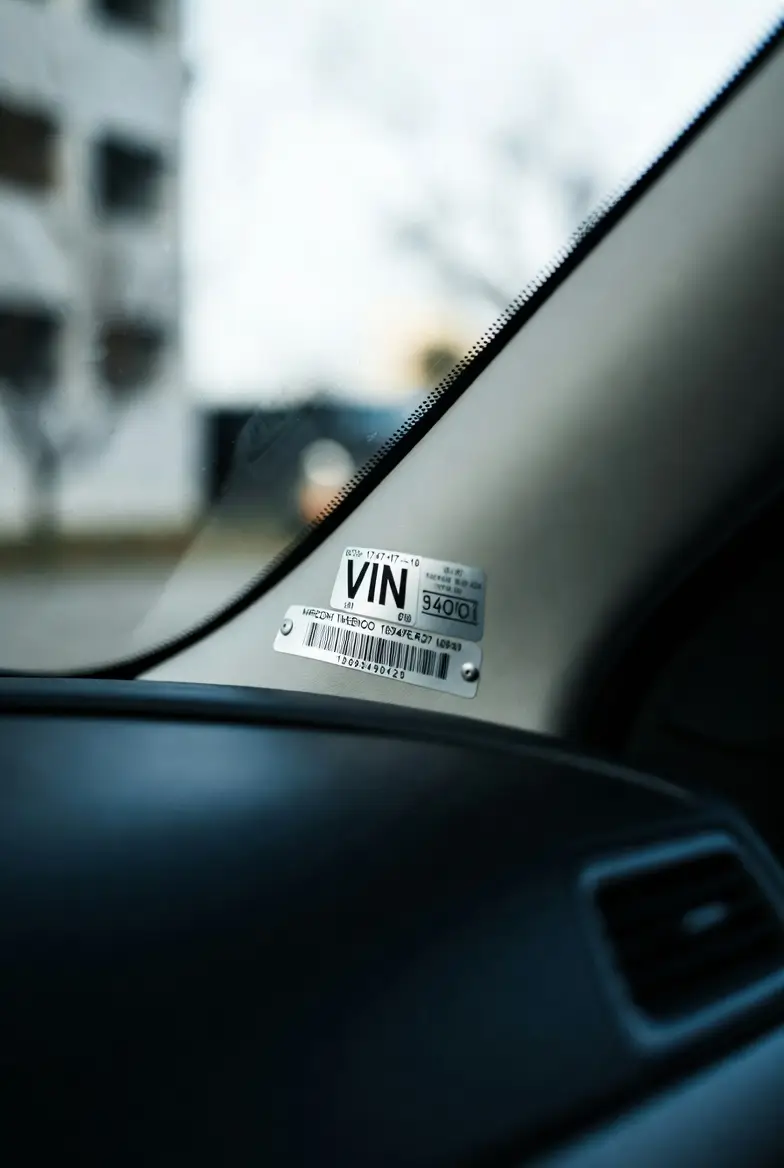
Locate the VIN. Common spots: lower driver-side windshield corner (visible from outside the car), the driver's door jamb sticker, the vehicle title, and the registration card.
Confirm it's 17 characters with no letters I, O, or Q — those are excluded industry-wide to avoid confusion with 1 and 0.
Identify the WMI (first 3 characters) to confirm manufacturer and country. This alone can flag a VIN that doesn't match the vehicle it's supposedly attached to.
Read the VDS (positions 4–8) for model, body style, and engine — manufacturer-specific tables are needed here, since each brand encodes this section differently.
Verify the check digit (position 9) using a VIN validator if you want to confirm authenticity before relying on the rest of the decode.
Decode the model year (position 10) using the standard year-letter cycle.
Check the VIS (positions 12–17) for the production sequence number, useful for confirming a vehicle isn't a duplicate or reassigned VIN.
Decoding Differs by Vehicle Type
Cars and light trucks follow the ISO 3779 standard closely, and most mainstream decoders handle them well. Motorcycles and powersports vehicles — ATVs, UTVs, snowmobiles — use a modified version of the same overall standard, but manufacturers encode engine displacement and model line differently in the VDS section than a car manufacturer would.
This is why a generic decoder often returns incomplete or generic results for motorcycles and powersports vehicles: the brand-specific knowledge of how that manufacturer structures the VDS section matters more than for a mainstream car, where cross-manufacturer conventions are more standardized.
VIN Decoding vs. VIN Check: What's the Difference?
These terms get used interchangeably, but they answer different questions. A VIN decode tells you what the vehicle was built as — model, engine, trim, plant, year. A VIN check (sometimes called a vehicle history report) tells you what has happened to that vehicle since it left the factory — accidents, title brands, flood damage, odometer readings, ownership changes, and open recalls.
Both matter, but for different reasons. Decoding confirms a listing's factory claims. Checking confirms the vehicle's condition and history. Relying on only one leaves a real gap: a vehicle can decode perfectly as a fully-loaded trim and still have a branded salvage title or a rolled-back odometer that decoding alone will never reveal.
Where to Decode a VIN for Free
The NHTSA's VIN decoder (vpic.nhtsa.dot.gov) is a solid free starting point for basic specs on cars and light trucks sold in the US. It pulls from manufacturer-submitted data and covers make, model, year, engine, and safety equipment reasonably well for mainstream vehicles.
For a faster, more complete breakdown — including build-specific options — running the VIN through VINspectorAI decodes the same core data instantly and adds context most basic decoders skip, such as flagging when a listing's claimed specs don't match the vehicle's actual build.
Common VIN Decoding Mistakes to Avoid
Assuming all 17-character VINs decode the same way. They don't — a generic decoder built around mainstream car conventions can misread motorcycle or powersports VINs.
Skipping the check digit. It's the fastest fraud check available and takes seconds to verify.
Confusing decode results with condition. A perfect decode says nothing about whether the vehicle has been in an accident or has a clean title.
Ignoring plant code mismatches. A vehicle claiming a specific origin with a plant code that doesn't match is worth a second look, even if the rest of the VIN checks out.
Relying on a seller's typed VIN without verifying it against the physical plate. Transcription errors happen more often than buyers expect.
VIN Myths Worth Correcting
"A clean-looking VIN plate means the vehicle is fine." Not necessarily. A VIN plate can look pristine while the vehicle underneath has a branded title, flood damage, or a rolled-back odometer. The plate's condition says nothing about the vehicle's history — only a full check does that.
"If the VIN decodes, the vehicle isn't stolen." A decode only confirms the VIN follows a valid format and matches a real manufacturer record. It doesn't check theft databases. A cloned VIN — copied from a legitimate vehicle onto a stolen one — will often decode without any red flags, because the underlying VIN itself is genuine; it's just attached to the wrong car.
"Dealers always verify VINs before selling." Licensed dealers are required to disclose known title issues in most states, but that doesn't mean every VIN gets independently re-verified against theft and salvage databases before a sale. Private sellers have even less obligation to check. The responsibility to verify usually falls on the buyer.
"A VIN decoder and a Carfax-style report are the same thing." They're not, and conflating them is one of the most common mistakes buyers make. A decoder reads the vehicle's built-in specifications. A history report pulls from external databases — insurance claims, state title records, auction records — that have nothing to do with the VIN's internal structure.
Real-World Scenarios Where VIN Decoding Catches Problems
Scenario 1 — Mismatched trim. A listing describes a "fully loaded" SUV with a premium package. Decoding the VIN shows the base trim code instead. This doesn't necessarily mean fraud — the seller may be mistaken — but it's worth clarifying before a deposit changes hands.
Scenario 2 — Wrong engine for the model. A used truck is listed with a larger engine than what the VIN's VDS section indicates. Engine swaps do happen legitimately, but an undisclosed swap can affect insurance, emissions compliance, and resale value.
Scenario 3 — Inconsistent plant code. A vehicle advertised as imported from a specific country decodes with a plant code from a different region entirely. This is usually a simple case of seller confusion, but occasionally points to a VIN that's been altered or misapplied.
Scenario 4 — Failed check digit. Running the VIN through a validator returns a check digit mismatch. This is the clearest signal something is wrong — either a transcription error somewhere in the listing, or a VIN that's been deliberately altered.
None of these scenarios prove wrongdoing on their own. They're signals to ask more questions, request documentation, or walk away — not automatic reasons to assume the worst.
Comparing VIN Decoding Tools
Not all decoders pull from the same data sources, and the differences show up most on non-mainstream vehicles.
Tool Type | Best For | Limitations |
|---|---|---|
NHTSA vPIC decoder | Free basic specs on cars/light trucks | Limited depth on motorcycles, powersports, and older vehicles |
Manufacturer-specific decoders | Brand-accurate trim and package details | Only covers one brand; not useful for cross-shopping |
General paid VIN check services | Full history alongside basic decode | Quality and database coverage varies significantly by provider |
AI-assisted platforms (e.g., VINspectorAI) | Combined decode + history + plain-language explanation | Still limited by the same underlying public and licensed data sources as any provider |
The practical takeaway: for a quick spec check, a free decoder is fine. For an actual purchase decision involving real money, pairing a decode with a full history check closes gaps that no decoder alone can cover.
Why a Basic Decoder Isn't Enough
A VIN decoder tells you what the vehicle was built as. It does not tell you what happened to it since — accidents, flood damage, title brands, odometer rollbacks, or theft recovery. Those require a full vehicle history report, not just a decode. If you're evaluating a used vehicle in California or Florida, pairing a VIN decode with a history report closes that gap and gives a much fuller picture before you commit to a purchase.
Brand-Specific VIN Decoding Guides
Different manufacturers structure the VDS section differently. If you need more than the basics, pick the guide for your brand:
Frequently Asked Questions
Get answers to common questions about How to Decode a VIN Number: Complete 2026 Guide | VinSpectorAI
Uncover Complete Vehicle History Reports
Discover critical vehicle information before you buy. Our VIN decoder reveals accident records, title status, recalls, and service history to help you make informed decisions.