How to Decode a BMW VIN Number: A Complete Trim & Engine Guide
A "330i" hasn't had a 3.3-liter engine in decades. BMW's naming convention stopped tracking actual displacement years ago — the number is now closer to a marketing tier than an engineering spec, and the letters that follow (i, e, d, M) carry more real information about what's under the hood than the number does. That gap between what the badge implies and what the car actually is makes BMW one of the few brands where decoding the VIN isn't just good practice — it's often the only reliable way to confirm what you're actually buying.
Here's how to read a BMW VIN properly, why the badge alone can't be trusted the way it can on most other brands, and what a decode still won't tell you.
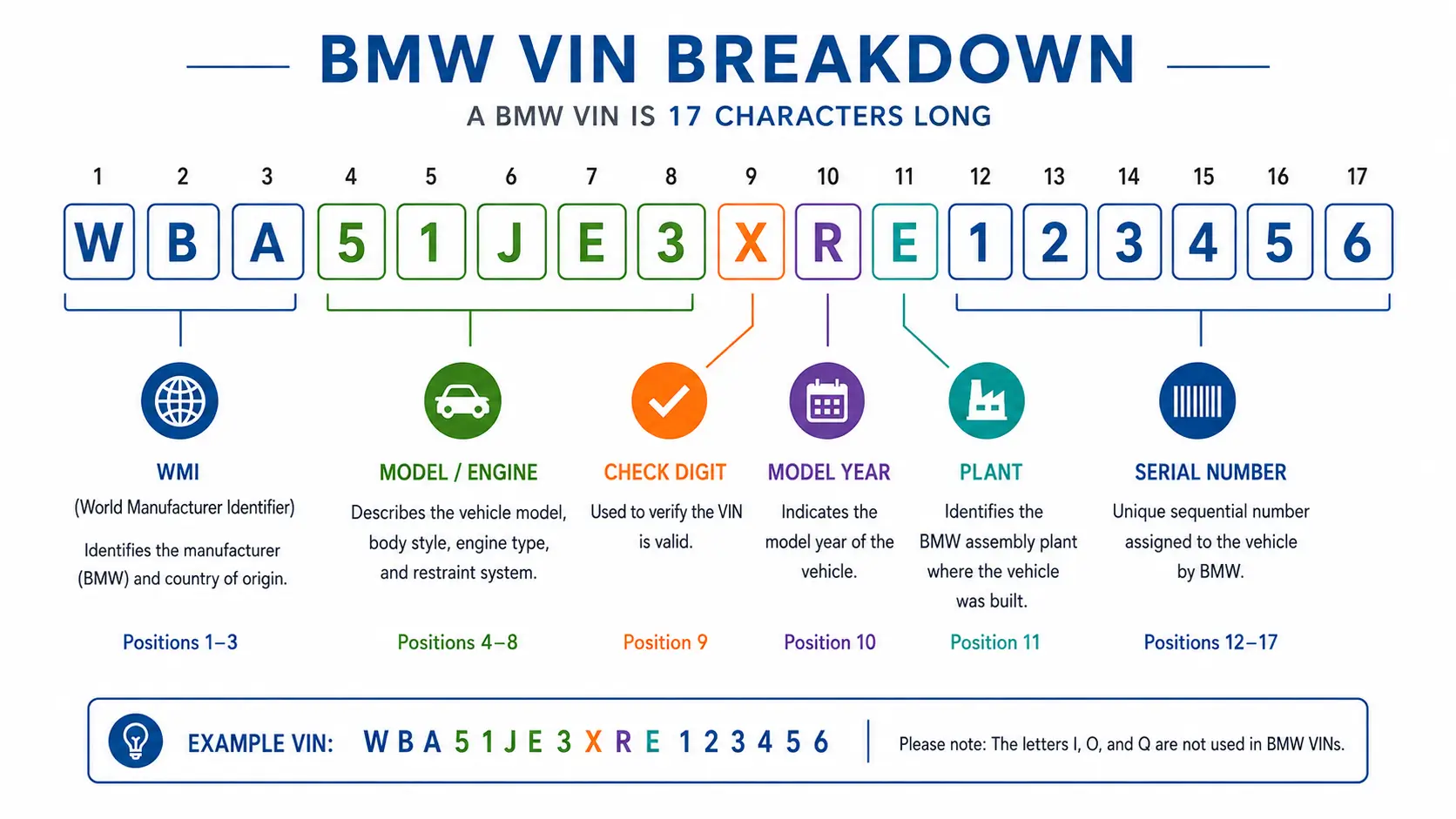
The 17 Characters, Position by Position
Positions | What It Tells You | Example |
|---|---|---|
1–3 | World Manufacturer Identifier — WBA for most U.S.-market cars, WBS for M models, 5UX/5YM for some SUVs | WBA5R |
4–8 | Model, body style, engine and restraint configuration | 330i, X3, M340i |
9 | Check digit | — |
10 | Model year | N = 2022 |
11 | Assembly plant | Munich, Spartanburg (SC), Dingolfing |
12–17 | Sequential production number | 234567 |
You'll find the VIN on the driver-side dashboard (visible through the windshield), the door jamb sticker, the title, and the insurance card. On a used BMW especially, cross-check all three — a badge on the trunk lid is the least reliable of the four sources, since dealers and previous owners occasionally swap badges during a trim upgrade or a cosmetic restyle.
For VIN basics that apply across every brand, see our general VIN decoding guide.
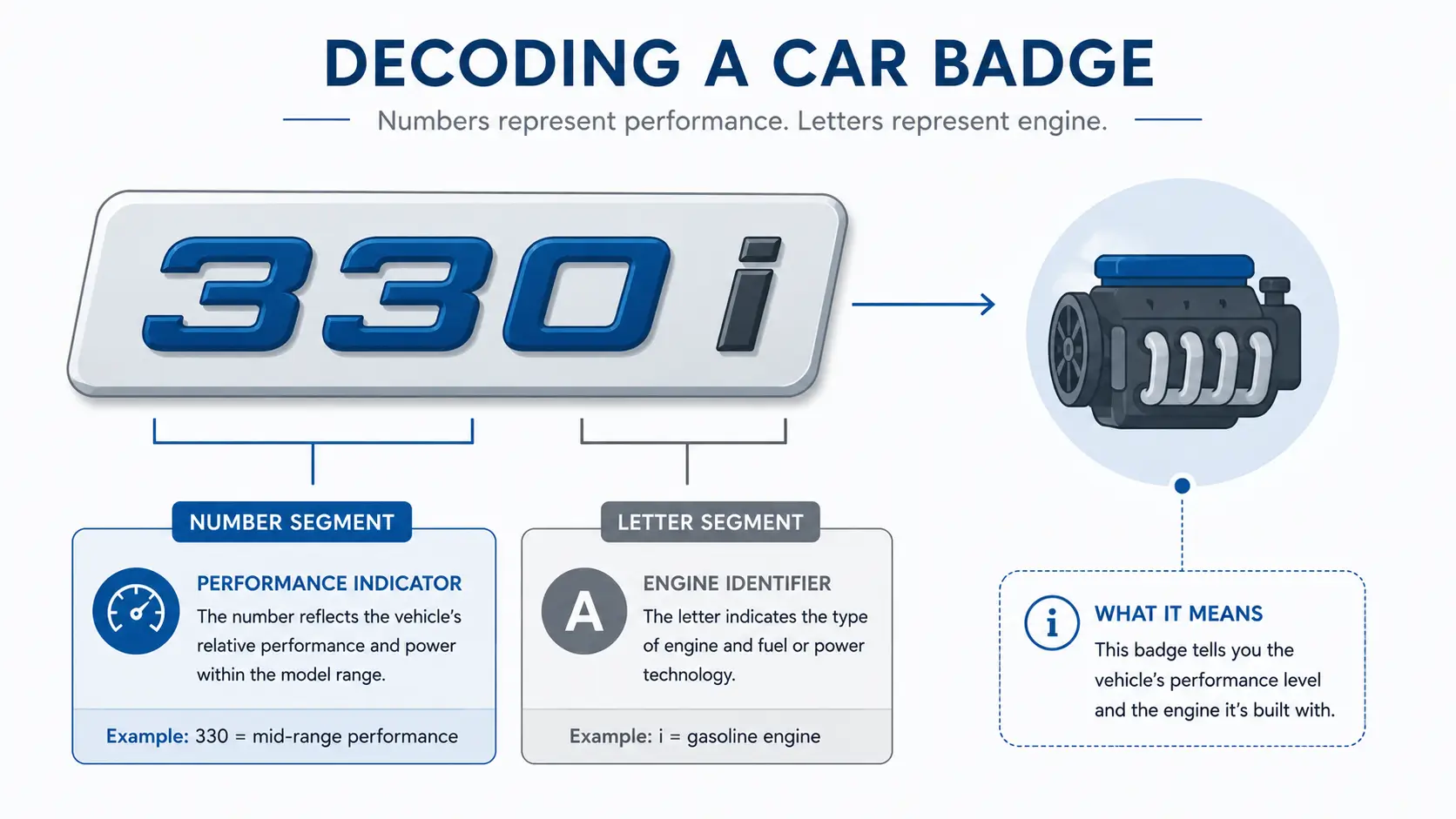
Why BMW's Badge Numbers Stopped Meaning What They Used To
BMW's naming system used to be simple: the number after the series (3, 5, 7) roughly matched engine displacement in liters. A "325i" had a 2.5-liter engine. That relationship broke down as BMW moved to smaller turbocharged engines that could match or exceed the output of older, larger ones — so today's "330i" runs a 2.0-liter turbo-four, not a 3.0-liter anything.
The letters matter more now than the number:
i — standard gasoline trim
e — plug-in hybrid variant (530e, 330e, X5 xDrive50e)
d — diesel, less common in current U.S. lineups
M or M-badged (M340i, M550i) — performance-tuned variant, distinct from a full "M" model like the M3 or M5
Two cars with nearly identical exterior badges can have meaningfully different engines, and a seller relying on memory or a mismatched badge can get this wrong without any intent to mislead. The VIN's VDS section (positions 4–8) is the only source that isn't subject to a badge swap or a seller's imperfect recall.
A Quick Reference for Common Suffixes
Suffix | Meaning | Example |
|---|---|---|
i | Standard gasoline engine | 330i, X5 xDrive40i |
e | Plug-in hybrid | 330e, 530e |
d | Diesel (less common in current US lineup) | 328d |
M / M-badged | Performance-tuned variant | M340i, M550i |
xDrive | All-wheel drive designation | X3 xDrive30i |
None of these suffixes are guaranteed by the number alone — a base 330i and a performance-oriented M340i can wear confusingly similar badge styling from a distance, which is exactly why confirming the VDS section matters before assuming the trim.
Decoding the VDS: Where the Real Engine Data Lives
Positions 4 through 8 carry the actual model, body configuration, and engine details — the section that resolves any conflict between what the trunk badge says and what the car is actually built as. If a listing advertises an M340i but the VDS decodes to a standard 330i configuration, that's a discrepancy worth resolving with the seller directly, not a detail to shrug off as a badge preference.
This matters financially, too: an M-badged or plug-in hybrid trim commands a real price premium over the base gasoline variant, and confirming the VIN matches the claimed trim protects you from paying that premium for a car that doesn't actually have it.
Why This Matters More on BMW Than Most Brands
Most manufacturers keep their naming reasonably consistent with what's under the hood, so a decode mostly confirms what a badge already told you. BMW's naming drift means the decode can actively contradict the badge — and when it does, the badge is wrong, not the VIN. Treat any BMW listing's trim claim as provisional until the VDS section confirms it, especially on performance and hybrid variants where the price difference is largest.
A Note on BMW's Model Pages
Unlike some other manufacturers, BMW's individual model reliability data on VINspectorAI is organized by specific trim (M340i, 530e, X7, and similar) rather than by general series name — so a search for "3 Series reliability" or "5 Series reliability" won't always return a clean match. If you're researching a specific BMW before buying, search by the exact trim designation from the VDS decode rather than the series number alone. Run a BMW VIN check directly on the exact VIN for the most reliable results.
What a Decode Still Won't Tell You
Confirming the trim and engine is only half the picture. A clean decode says nothing about:
Recall completion status on the exact VIN
Accident and structural damage history
Title brands — see what a branded title means if the terminology is new
Odometer consistency across service records
Whether the car was previously used for track days, which can accelerate wear well beyond what mileage alone would suggest
Checking Recall Status the Right Way
NHTSA's VIN lookup confirms a recall campaign applies to the model and year — not that the specific car received the fix.
Dealer service records, if available, should show a completed repair order dated after the campaign's issue date.
A full VIN history report cross-references completion status directly, without a call to a BMW service center.
This matters more on BMW than the badge alone suggests: performance and hybrid trims often carry their own separate recall campaigns distinct from the base gasoline model sharing the same body style.
Listing Details Worth a Second Look
An "M340i" or similarly performance-badged listing where the VDS section doesn't confirm the claimed trim.
A plug-in hybrid ("e" trim) advertised with no mention of battery health or hybrid-system service history.
Recently swapped badges on the trunk lid with no explanation — occasionally cosmetic, occasionally a sign the seller is dressing up a base trim.
A clean-title claim with nothing in writing to support it.
Any track-day or performance-club history mentioned casually but not reflected in service records — worth asking about directly given how much harder driving can accelerate wear.
Before You Sign Anything
Decoding confirms the trim and engine actually match what's advertised — genuinely more important on a BMW than on most brands, given how far the badge alone has drifted from the underlying spec. A full BMW VIN check on VINspectorAI goes further: recall completion, accident history, and title status tied to that exact VIN.
Frequently Asked Questions
Get answers to common questions about How to Decode a BMW VIN Number: A Complete Trim & Engine Guide
Uncover Complete Vehicle History Reports
Discover critical vehicle information before you buy. Our VIN decoder reveals accident records, title status, recalls, and service history to help you make informed decisions.