Nissan VIN Decoder: Read Any Nissan VIN by Plant, Year and Engine
You're looking at a used Altima, Rogue or Sentra and the listing says "2019, 2.5L, built in the USA." Is that true? A Nissan VIN decoder answers that in about ten seconds, because every one of those facts is written into the 17 characters stamped on the car. This guide shows you how to read them yourself, what we got when we ran real Nissan VIN patterns through NHTSA's decoder, and the one thing no decoder can show you.
Nissan VIN decoder guide showing the 17 VIN characters split into WMI, descriptor and serial sections
What does a Nissan VIN actually tell you?
A Nissan VIN is a 17-character code that identifies who built the vehicle, what it was built as, which model year it belongs to and which plant assembled it. It doesn't record accidents, owners, mileage or title history.
What a decode shows
Make, model, model year, body style, engine size, drive type, trim and assembly plant. That is the factory description of the car, and it's what you compare against the listing.
What a decode doesn't show
Anything that happened after the car left the factory. A decode tells you what the vehicle was built as. A check tells you what has happened to it since. Those are two different tools, and we cover the second one further down.
Where do you find the VIN on a Nissan?
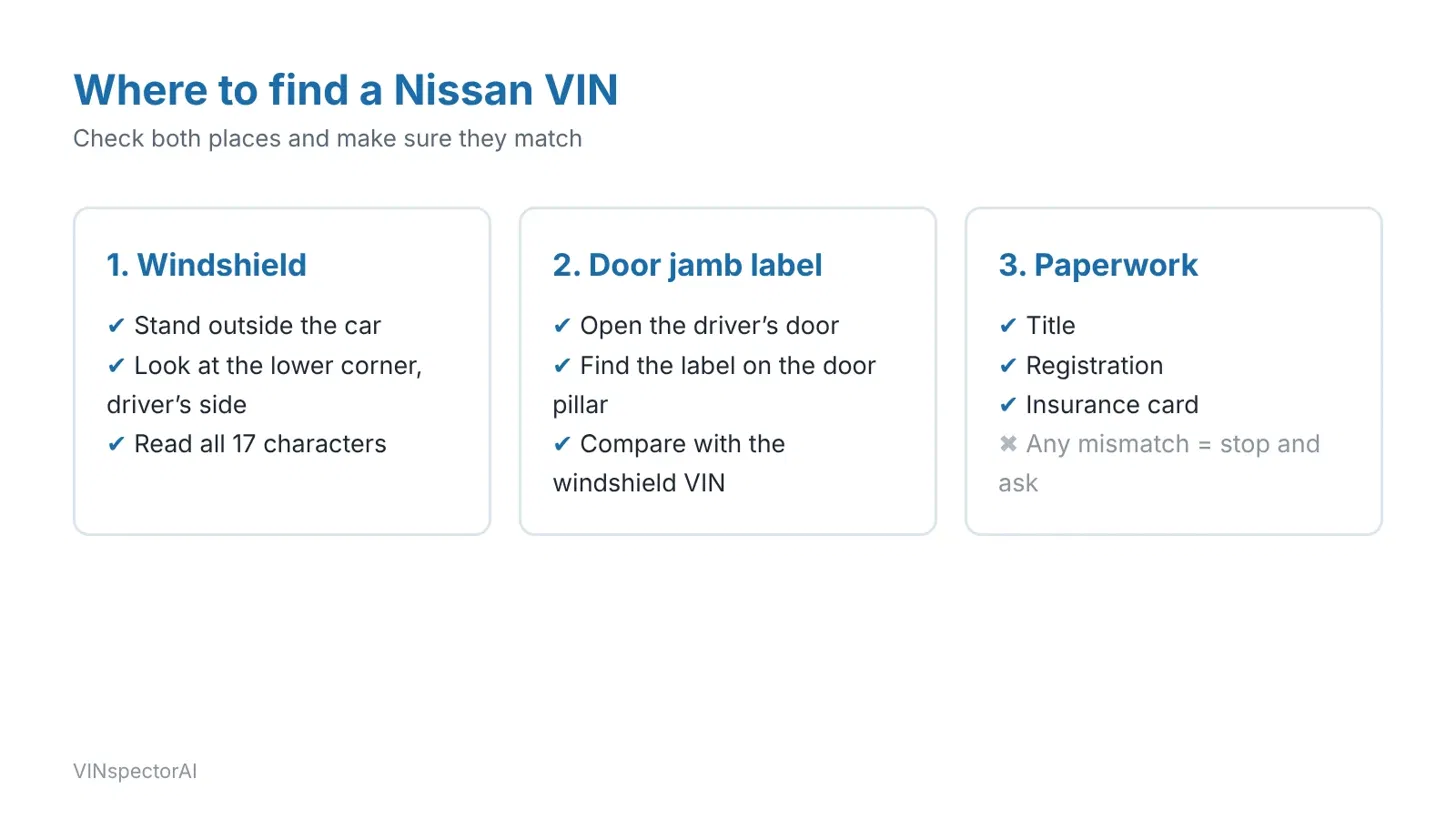
On most Nissans you can read it through the windshield, at the base on the driver's side, and again on the label on the driver's door jamb. It's also on the title, registration and insurance card.
Dashboard and door jamb
Checklist of three places to find a Nissan VIN: windshield, driver's door jamb label and paperwork
Stand outside the car and look through the lower driver's-side corner of the windshield. Then open the driver's door and read the label on the door pillar. The two should match, character for character.
Paperwork
Compare the VIN on the title with the one on the car. A mismatch is a reason to walk away or at least to pause the deal until the seller explains it.
Under the hood and other stamped spots
Some vehicles carry the VIN in additional places, such as the engine bay. We haven't checked every Nissan model, so use the dash and door jamb as your standard and treat other locations as a bonus cross-check.
How do you read a Nissan VIN, position by position?
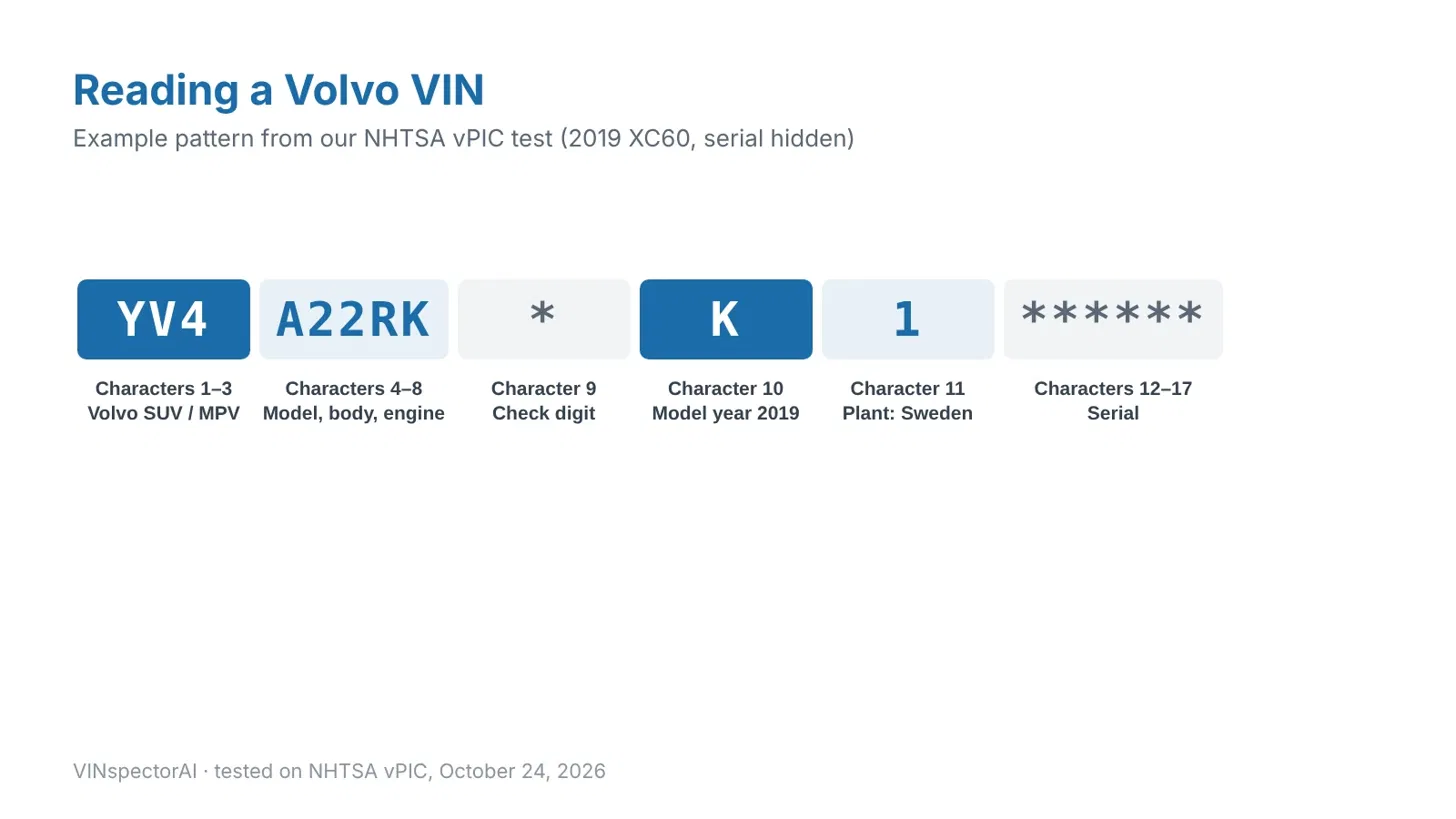
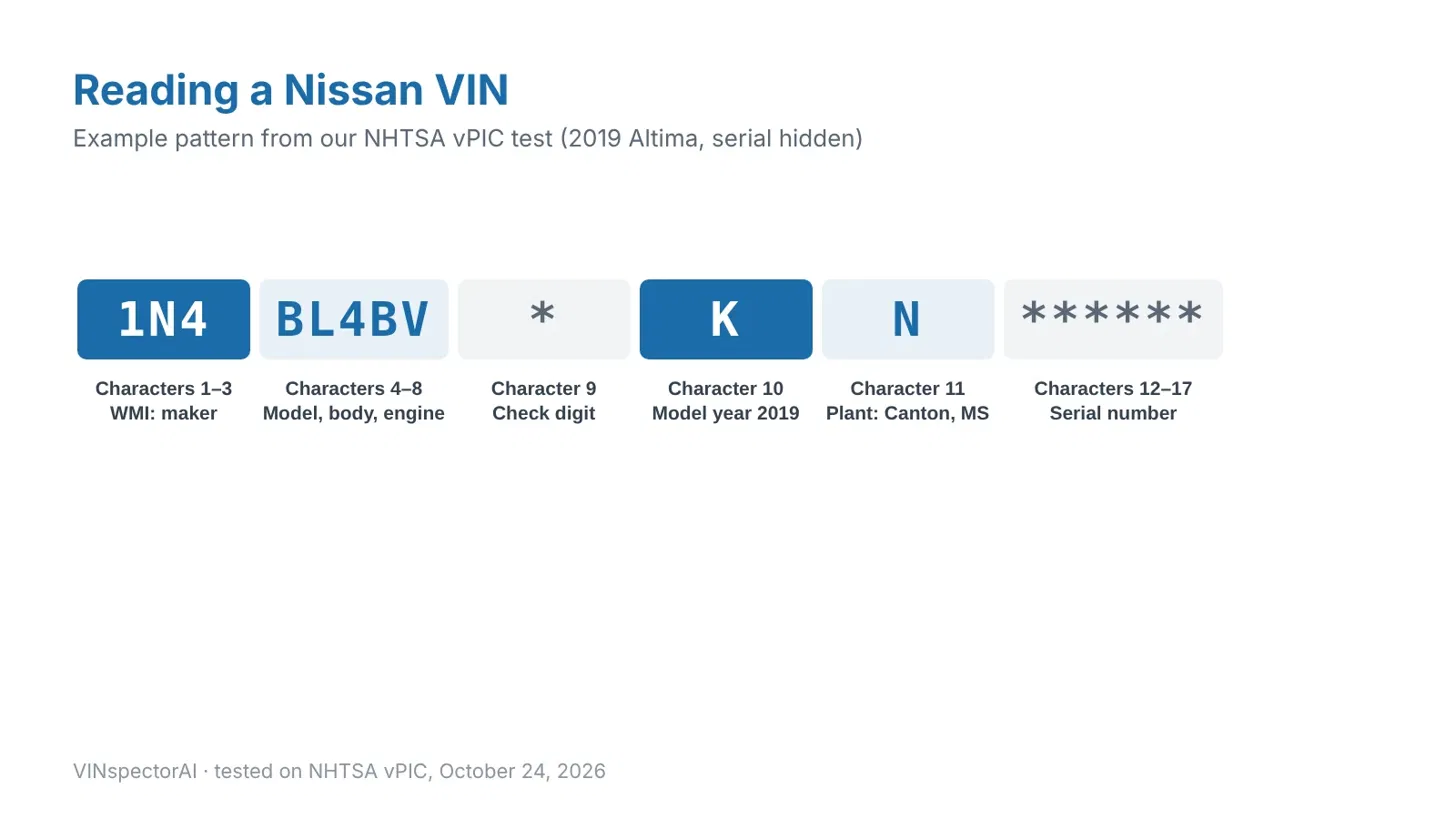
You read it in blocks: characters 1–3 name the manufacturer, 4–8 describe the vehicle, 9 is a check digit, 10 is the model year, 11 is the assembly plant, and 12–17 are the serial number.
Position | Name | What it tells you | Example from our tests |
|---|---|---|---|
1–3 | WMI | Manufacturer and vehicle type | 1N4, 5N1, 3N1 |
4–8 | Descriptor | Model line, body, engine, restraints (varies by model) | BL4BV (Altima) |
9 | Check digit | Math test that catches mistyped VINs | A digit or X |
10 | Model year | One letter or number | K = 2019 |
11 | Plant | Where it was assembled | N = Canton, Mississippi |
12–17 | Serial | The car's unique production number | Six characters |
Characters 1–3: the WMI
This block says who made the vehicle. We'll decode the Nissan-specific ones in the next section.
Characters 4–8: the descriptor
Nissan uses these five characters to encode model, body, engine and restraint details, and the meaning of each character changes from model to model. That's why a general chart can't tell you what an "A" in position 5 means. A decoder with Nissan's registered patterns can.
Character 9: the check digit
It's calculated from the other 16 characters. If someone changes one character, the check digit stops matching. It's a quick way to spot a VIN that was typed wrong or altered. The letters I, O and Q are never used in a VIN at all, so a VIN containing them isn't valid.
Character 10: the model year
Letters and numbers cycle every 30 years, which is why we cover it in its own section below.
Character 11: the plant
One character that points to the factory. We tested three.
Characters 12–17: the serial number
These six characters separate your car from every other car built with the same description.
Why do Nissan VINs start with JN, 1N4, 5N1 or 3N1?
Because Nissan registers several different WMI codes, one for each combination of builder and vehicle type. We looked each one up on NHTSA's vPIC database.
WMI | Manufacturer listed on vPIC | Vehicle type on vPIC |
|---|---|---|
JN1 | Nissan Motor Company, Ltd | Passenger car |
JN8 | Nissan Motor Company, Ltd | Multipurpose passenger vehicle (MPV) |
1N4 | Nissan North America, Inc. | Passenger car |
5N1 | Nissan North America, Inc. | Multipurpose passenger vehicle (MPV) |
3N1 | Nissan Mexicana, S.A. de C.V. | Passenger car |
Data from NHTSA's vPIC decoder, checked October 24, 2026.
JN1 and JN8: Nissan Motor Company
vPIC lists both under Nissan Motor Company, Ltd. JN1 is a passenger car, JN8 an MPV. The "J" in position 1 is the standard country code for Japan.
1N4 and 5N1: Nissan North America
Both are registered to Nissan North America. 1N4 maps to passenger cars and 5N1 to MPVs such as crossovers and SUVs.
3N1: Nissan Mexicana
Registered to Nissan Mexicana, and in our test it matched a Sentra built in Aguascalientes.
Notice what this means in practice: the first character is a country of origin, not a guarantee about the model. A "5N1" tells you an MPV from Nissan North America, not that it's a Rogue.
How do you read the 10th character to get the model year?
Look at position 10 and match it to the table. Since 2010 the cycle runs from A, and it repeats every 30 years, so context (body style, technology) matters for older cars.
Character | Model year | Character | Model year |
|---|---|---|---|
F | 2015 | M | 2021 |
G | 2016 | N | 2022 |
H | 2017 | P | 2023 |
J | 2018 | R | 2024 |
K | 2019 | S | 2025 |
L | 2020 | T | 2026 |
The 30-year repeat trap
A "K" can mean 2019 or 1989. If the car has a touchscreen and a backup camera, it's 2019. Years are also model years, not build dates: a 2020 can be built in 2019.
Why the letters skip
You won't see I, O, Q, U, Z or 0 in the year position, which is why the sequence jumps from J to K and from N to P.
What did we find when we decoded real Nissan VINs on NHTSA?
We ran three Nissan VIN patterns through NHTSA's vPIC decoder on October 24, 2026. We used the first 8 characters plus the year and plant characters, with the serial replaced by a wildcard. NHTSA flagged each one as an incomplete VIN (error code 6), which is expected for a partial pattern. The decoded fields were still returned.
VIN pattern | Make / model / year | Plant | Engine and body (vPIC) |
|---|---|---|---|
1N4BL4BV*KN | Nissan Altima, 2019 | Canton, Mississippi, USA | 2.5L, sedan, 4x2, trim S |
5N1AT2MV*HC | Nissan Rogue, 2017 | Smyrna, Tennessee, USA | 2.5L, 4 cylinders, CUV, 4WD, CVT |
3N1AB8CV*LY | Nissan Sentra, 2020 | Aguascalientes, Mexico | 2.0L, sedan, 4x2, trim SV |
What came back blank
Engine model, transmission style and, for some, the cylinder count were empty. NHTSA notes that a blank means "no data," not "the feature isn't there." If a seller claims a specific engine and the decoder is blank, the answer is to ask for the window sticker, not to assume.
What this proves, and what it doesn't
It proves the plant and year characters decode as expected for these three patterns. We haven't tested every Nissan, Infiniti or older Datsun-era VIN, so treat our results as a method, not a guarantee.
How is a decode different from a Nissan VIN check?
A decode reads the factory description. A Nissan VIN check looks up what happened afterward: accidents, owners, title status, odometer readings and recalls. If you're deciding whether to buy, you need both.
Decode vs. history, side by side
What you want to know | VIN decoder | VIN check or history report |
|---|---|---|
Model year, engine, plant | Yes | Yes |
Trim and body style | Usually | Usually |
Accident or damage records | No | Yes, where reported |
Title brands (salvage, rebuilt) | No | Yes |
Odometer history | No | Yes |
Open recalls | No | Yes |
Run both before you pay
Start with a free Nissan VIN check to confirm the specs and see the headline flags. If the car is still on your list, a Quick Check goes deeper for a few dollars. Our guide to decoding any VIN explains the general method that applies to every brand.
What should you verify before buying a used Nissan?
Confirm the VIN matches in every place it appears, compare the decoded specs with the listing, and look up the car's history before you hand over a deposit.
Make the VIN match everywhere
Dash, door jamb, title and, if you have it, the window sticker. A window sticker by VIN shows the options the car left the factory with, and our guide to the colour code from the VIN helps when a repaint is in question.
Look at the brand's track record
Our Nissan reliability stats are built from NHTSA data and show how the brand's models compare on complaints and recalls. If you're weighing a specific model, start with the Nissan Armada or Nissan Kicks reliability pages to see which years draw the most complaints.
Compare with other Japanese brands
If you're cross-shopping, our decoders for Toyota, Mazda and Subaru use the same method, and the Volvo VIN decoder shows how a European maker structures its codes differently.
Run a free check on VINspectorAI before you put down a deposit, no account needed. Check Any VIN Free
Frequently Asked Questions
Get answers to common questions about Nissan VIN Decoder: Read Any Nissan VIN by Plant, Year and Engine
Uncover Complete Vehicle History Reports
Discover critical vehicle information before you buy. Our VIN decoder reveals accident records, title status, recalls, and service history to help you make informed decisions.