Mazda VIN Decoder: What Your Mazda's VIN Tells You (and What It Doesn't)
The ad says "2020 CX-5 Grand Touring, Japan-built, one owner." You can check most of that yourself in two minutes. A Mazda VIN decoder turns the 17 characters on the windshield into the model, year, engine and drivetrain. It also shows the factory that built the car: Hiroshima, Hofu, Mexico or Alabama.
We ran real Mazda VINs through NHTSA's free decoder for this guide. Here's what came back and what no VIN can tell you.
TL;DR: The first three characters show where a Mazda was built. JM1 or JM3 is Japan, 3MZ or 3MV is Mexico, and 7MM is Alabama. The 10th character is the model year and the 11th the plant. The VIN holds no paint code, option list or accident history.
How do you decode a Mazda VIN?
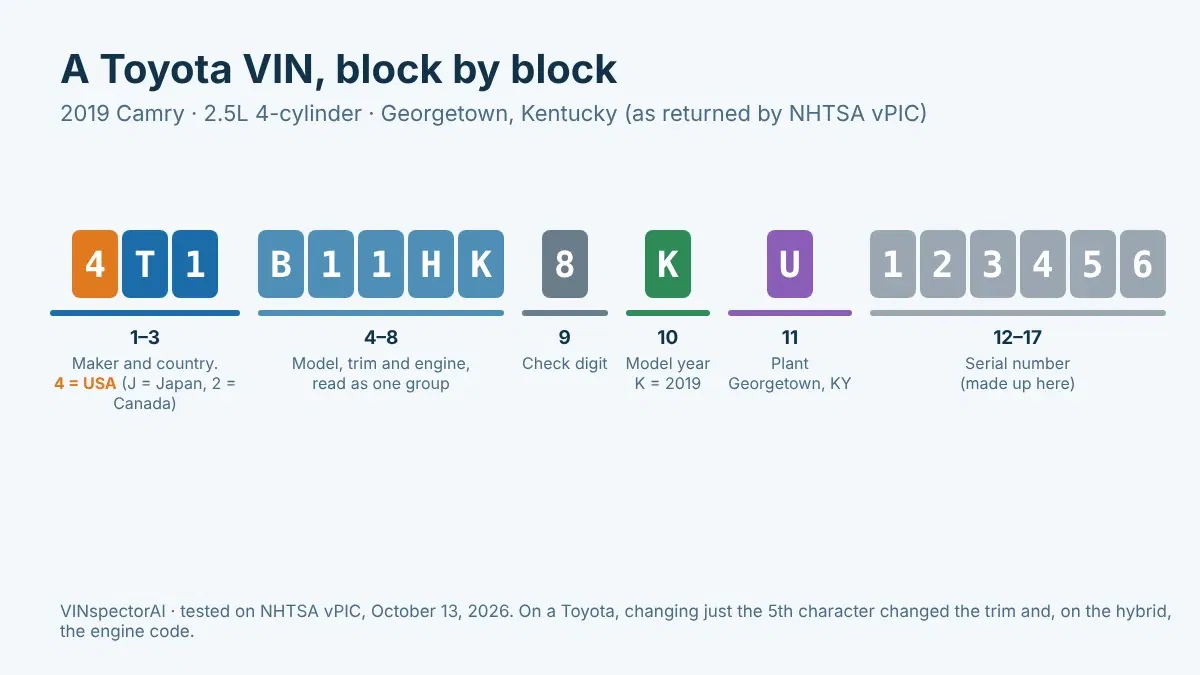
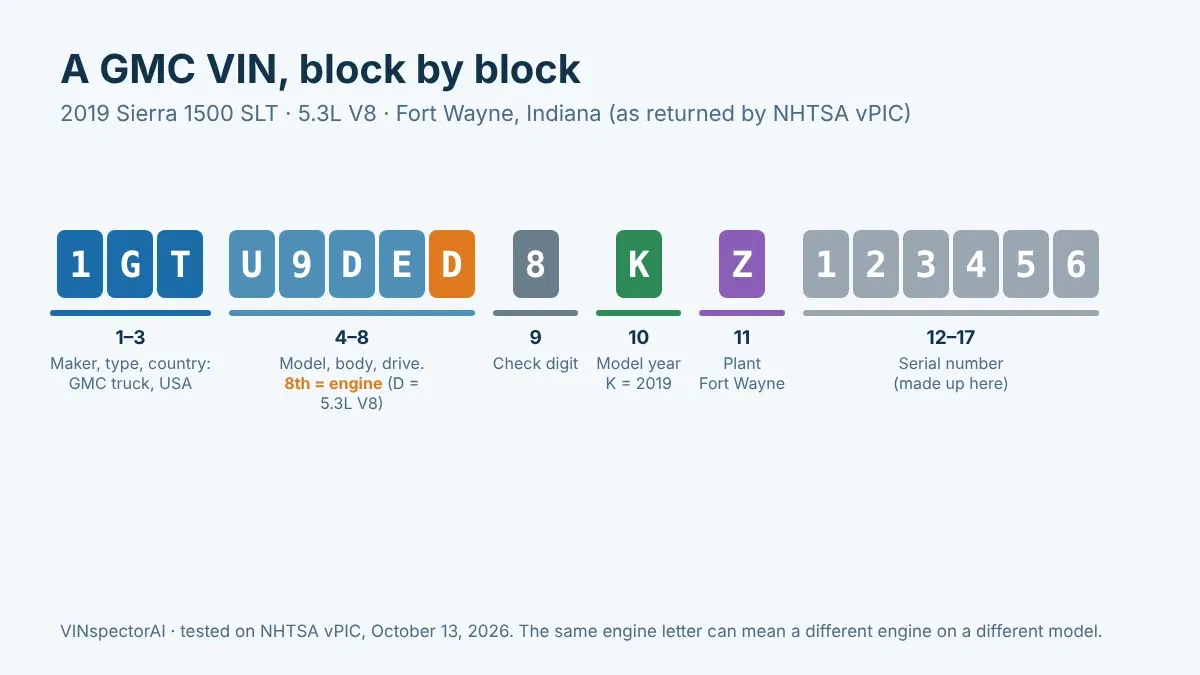
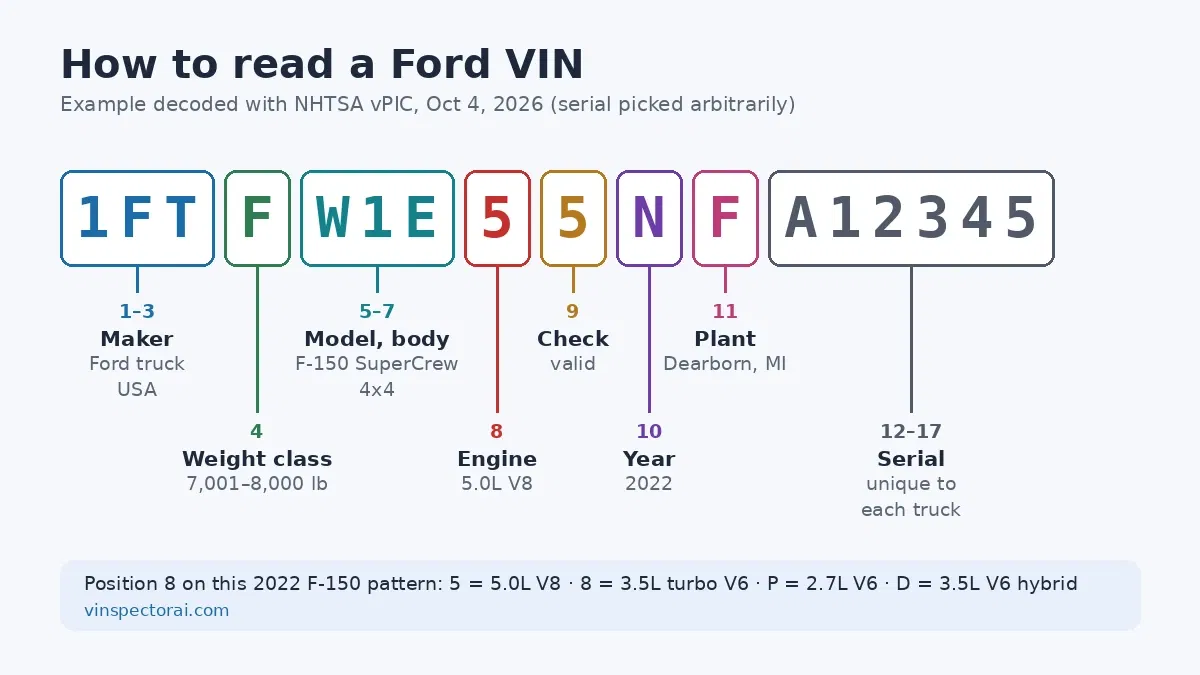
Read the 17 characters in six groups. 1–3 are the maker and country, 4–8 the model and engine, 9 a check digit, 10 the year, 11 the plant and 12–17 the serial. NHTSA's free vPIC decoder works as a Mazda VIN decoder and confirms every position for you.
Where is the VIN on a Mazda?
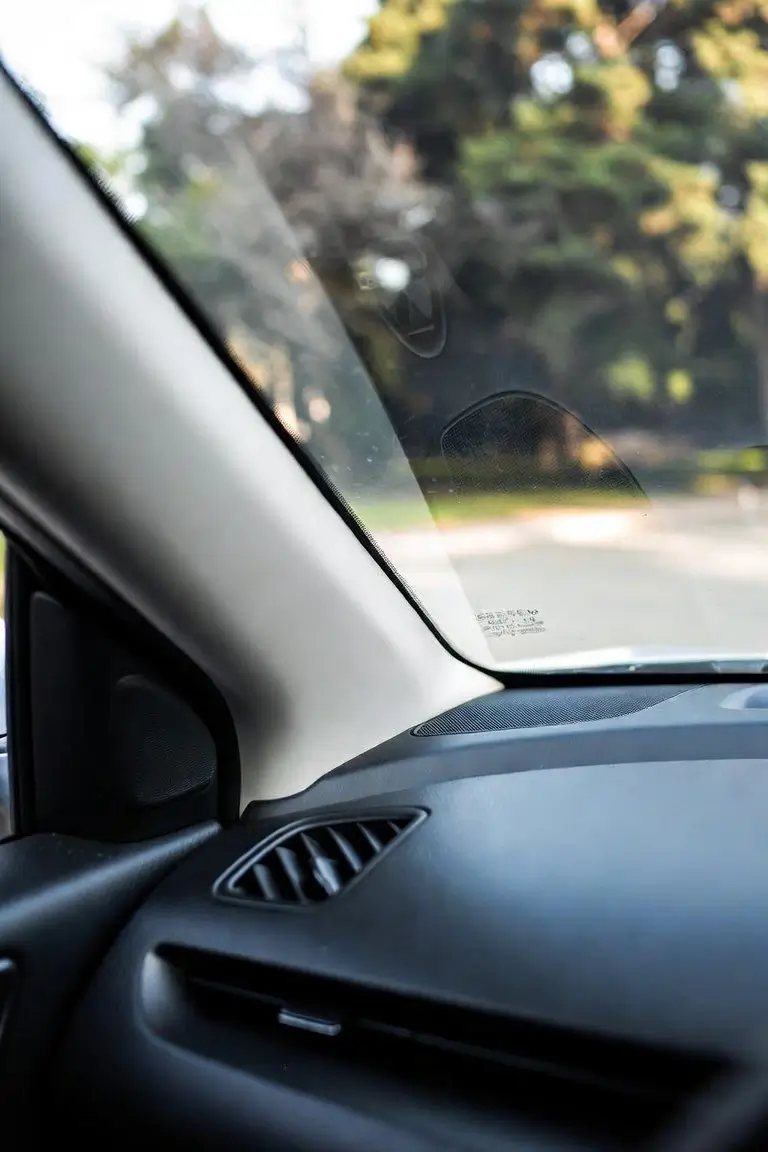
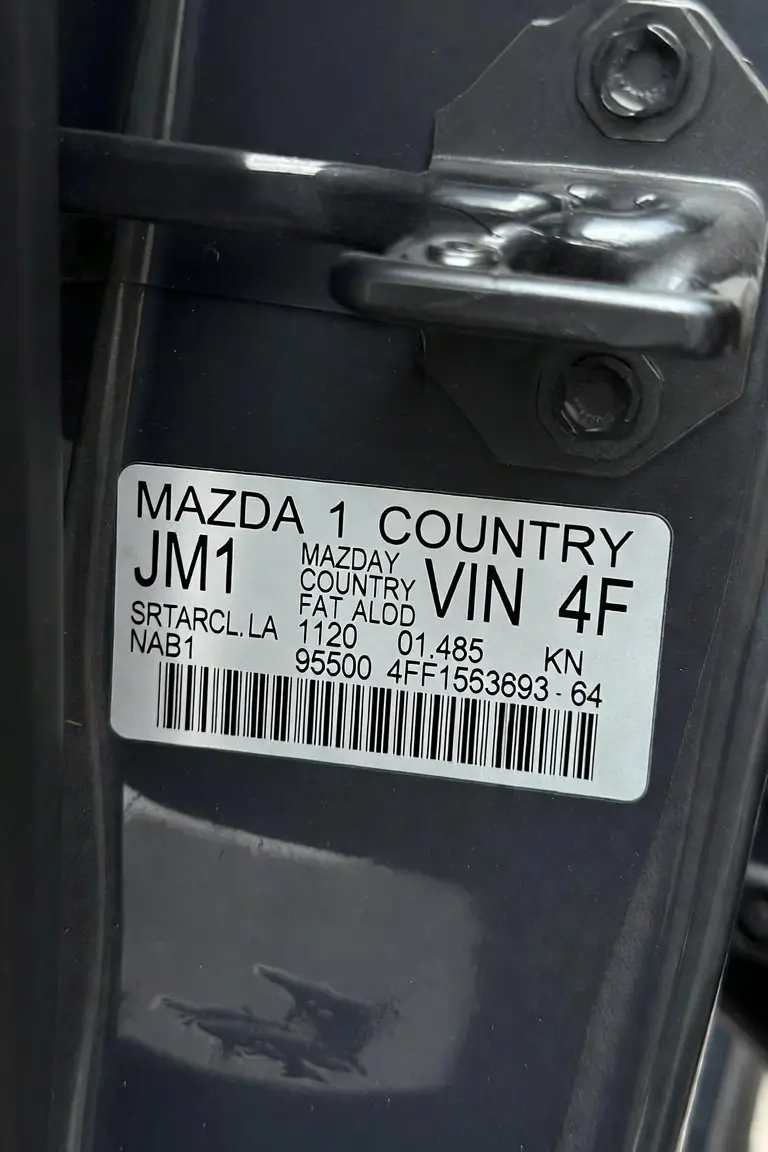
Mazda's US owner's manual says the VIN "is on a plate attached to the cowl panel located on the left corner of the dashboard. This plate can easily be seen through the windshield" (Mazda USA, 2022 Mazda3 manual). It's also on the driver's door jamb label and on the car's paperwork, which is where any Mazda VIN decoder starts.
Federal rules require that windshield VIN to be readable from outside the car, standing "adjacent to the left windshield pillar" (49 CFR 565.13). If the plate is covered, scratched or doesn't match the door label, stop until someone explains why.
What does a Mazda VIN look like?
Here's a VIN in the format Mazda uses: JM1BPABL6K1012345. The serial number at the end is made up for this guide, but the rest is valid. On October 1, 2026 we ran it through NHTSA vPIC, and the right-hand column shows what came back
How to Read the VIN — Breakdown by Position
Every Mazda VIN follows the same 17-character structure used across the industry since 1981. Each section decodes a different part of the vehicle's identity.
Position | Section | What It Tells You |
|---|---|---|
1–3 | WMI (World Manufacturer Identifier) | Manufacturer and country of assembly |
4–8 | VDS (Vehicle Descriptor Section) | Model line, body style, engine type, restraint system |
9 | Check digit | Mathematically validates the entire code |
10 | Model year | Standard industry letter/number code |
11 | Plant code | Which factory built the vehicle |
12–17 | VIS (Vehicle Identifier Section) | Sequential production number, unique to that vehicle |
What do JM1, JM3, 3MZ and 7MM mean?
The first three characters are the World Manufacturer Identifier. NHTSA's list of Mazda WMIs shows JM1 for Mazda Motor Corporation passenger cars and JM3 for its SUVs, both in Japan. 3MZ, 3MY and 3MD are cars and 3MV is an SUV from Mazda's plant in Mexico. 7MM and 7MU are SUVs from Mazda Toyota Manufacturing, USA.
Mazda's 2023 VIN format filed with NHTSA names the Mexican models. 3MZ is the Mazda3, 3MD the Mazda2 and 3MV the CX-30 (Mazda VIN format, NHTSA).
Some older US Mazdas were built by Ford. NHTSA's WMI decoder lists 4F2 as a Ford-built Mazda SUV and 4F4 as a Ford-built Mazda truck.
If the prefix doesn't fit the vehicle, ask why, because a Mazda VIN decoder will happily decode a VIN that belongs to a different car. A CX-5 listed as an SUV should carry an SUV prefix such as JM3, not a passenger-car one.
How does the check digit work?
The 9th character is a math check computed from the rest of the VIN, under the federal VIN rules (49 CFR Part 565). Change one character and it usually stops matching, which catches typos and crude fakes. Every Mazda VIN we tested for this guide passed, and a good Mazda VIN decoder flags one that doesn't.
How do I find the model year from a Mazda VIN?
Look at the 10th character. This is the model year set by 49 CFR 565.15, and the same codes apply to every brand.
Code | Model year | Code | Model year | Code | Model year |
|---|---|---|---|---|---|
A | 2010 | G | 2016 | N | 2022 |
B | 2011 | H | 2017 | P | 2023 |
C | 2012 | J | 2018 | R | 2024 |
D | 2013 | K | 2019 | S | 2025 |
E | 2014 | L | 2020 | T | 2026 |
F | 2015 | M | 2021 | V | 2027 |
The letters I, O and Q are never used in a VIN, and U and Z are skipped in the year cycle. This is the model year, not the build month.
Was my Mazda made in Japan, Mexico or the US?
Look at the first characters: for a Mazda, J means Japan, 3M means Mexico and 7M means the Alabama plant, according to NHTSA's Mazda codes. Older US-built Mazdas start with 1YV or 4F instead, and a full Mazda VIN lookup on NHTSA vPIC names the exact plant.
What our NHTSA tests showed
We decoded four real Mazda VINs that appear in public listings in Google results. We show only the first 11 characters here, which is everything that identifies the model, year and plant.
VIN starts with | Model | Plant returned by NHTSA vPIC |
|---|---|---|
JM1BPABL1K1… | 2019 Mazda3 sedan | Hofu, Yamaguchi, Japan |
JM3KFBDM1L0… | 2020 CX-5 Grand Touring | Hiroshima, Japan |
7MMVAAEW1SN… | 2025 CX-50 Premium Plus | Huntsville, Alabama, USA (Mazda Toyota Manufacturing) |
1YVFP80D335… | 2003 Mazda6 sedan | Flat Rock, Michigan, USA (AutoAlliance International) |
We got this wrong ourselves. An earlier version of this guide said the Mazda3 is built in Hiroshima and that older Mazda6 sedans start with 4F. When we decoded real VINs for this update, the 2019 Mazda3 came back from Hofu. The 2003 Mazda6 from Flat Rock started with 1YV, not 4F, which NHTSA lists for Ford-built Mazda SUVs and trucks.
That's why we now check every plant claim against NHTSA instead of repeating what other guides say.
Which Mazda3 is made in Japan?
Check the VIN, not the badge. A Mazda3 whose VIN starts with JM1 was built in Japan. One that starts with 3MZ, 3MY or 3MD came from Mazda's plant in Mexico, according to NHTSA's codes.
How do you read a Miata VIN?
An MX-5 Miata VIN starts with JM1, the same Mazda Motor Corporation passenger-car code as the Mazda3. We entered the partial VIN JM1NDAD7*K0 in NHTSA vPIC. It returned a 2019 MX-5 Grand Touring soft top with a 2.0-liter engine, built in Hiroshima, Japan.
The 11th character matches Mazda's filing with NHTSA, where 0 is Hiroshima and 1 is Hofu (Mazda VIN format, NHTSA). In our tests the MX-5 and CX-5 carried a 0 and the Mazda3 a 1. Run all 17 characters to confirm the plant for the exact car.
Can a Mazda VIN tell me the trim, window sticker or paint code?
The trim sometimes, the window sticker and paint code never. In our tests, NHTSA's decoder named the trim for the CX-5, CX-50 and MX-5, but not the Mazda3. The sticker and paint code you look up separately, using the VIN.
What to do when the trim comes back blank
If a Mazda VIN decoder doesn't name the trim, compare the equipment on the car with the original window sticker (covered below). Our Mazda3 decode still came back "decoded clean" with the trim field empty. A blank field means vPIC has no data for it, not that the VIN is wrong.
Engine and drivetrain
These came back for every full VIN we tested. The Mazda3 decoded as a 2.5-liter car with front-wheel drive ("4x2"). The CX-5 and CX-50 both decoded as 2.5-liter models with "4WD/4-Wheel Drive/4x4."
The window sticker (Monroney label)
Federal law requires every new car to carry a label showing its suggested retail price and the price of each factory option (15 U.S.C. § 1232). That makes the original sticker the closest thing to a build sheet. It's also the best way to check a "fully loaded" claim.
Ask a Mazda dealer whether they can pull it from the VIN, and see our window sticker by VIN guide for other routes.
The paint code
Mazda paint codes are on a Color ID tag, most often "on the driver-side door jamb or door frame" (PaintScratch). They're usually "2 to 3 characters, such as 41V, 46G, 46V, or A4A." A VIN "may help identify the original paint, but it is not the paint code or formula to use when ordering."
If the tag is gone, our guide to finding a car's color code covers other places to look.
How do I check Mazda recalls by VIN?
Enter the VIN in NHTSA's recall lookup, which shows safety recalls from the past 15 years that haven't been repaired on that specific car. Mazda USA's own recall lookup also shows Special Service Programs and covers recalls reported in or after 1999.
Recall repairs are free
Mazda USA states that "all safety recall repairs are made free of charge." An open recall isn't a reason to skip a car, but it's a fair point to raise with the seller before you pay.
What our Mazda data shows
Across Mazda models, our Mazda reliability data tracks 1,405 NHTSA complaints, 66 recall campaigns and 84 crash-related complaints. In that data the Mazda3 has the most complaints (616) and the most recall campaigns (29), followed by the CX-9 with 433 complaints.
What should you check beyond a Mazda VIN decoder before you buy?
Check that the VIN matches on the windshield, the door jamb and the title, and that the prefix, year and plant fit the ad. Then check what no Mazda VIN decoder can show: a salvage or flood title, a past accident, an odometer rollback or a theft record.
What a decoder can't tell you
A decoder confirms what the car was when it left the factory. Title, insurance and theft records are where a car's later life shows up, and that's what a vehicle history report checks.
Cars registered in more than one state
If the Mazda has been titled in several states, check records from each one, because that's how title washing hides a branded title. Buying in California? Start with that state's records, then look further back.
Run the full check before you pay
Our Mazda VIN check pulls title, accident and recall records for the exact car and gives you a plain-English verdict. Buying in Texas? The same records apply there. For the rules that apply to every brand, see how to decode a VIN number.
The VIN tells you what your Mazda was when it left Hiroshima, Hofu, Mexico or Alabama. It can't tell you what happened since. Run a free check on VINspectorAI before you put down a deposit, no account needed.
Frequently Asked Questions
Get answers to common questions about Mazda VIN Decoder: What Your Mazda's VIN Tells You (and What It Doesn't)
Uncover Complete Vehicle History Reports
Discover critical vehicle information before you buy. Our VIN decoder reveals accident records, title status, recalls, and service history to help you make informed decisions.