Porsche VIN Identification: Reading Your Chassis Number | VinSpectorAI
Porsche buyers care about provenance more than almost any other used-car segment — the difference between a Carrera S and a base Carrera, or between a factory Sport Chrono car and a standard one, can mean tens of thousands of dollars. The VIN, often called a chassis number in Porsche circles, is where that provenance starts.
Where to Find the Chassis Number
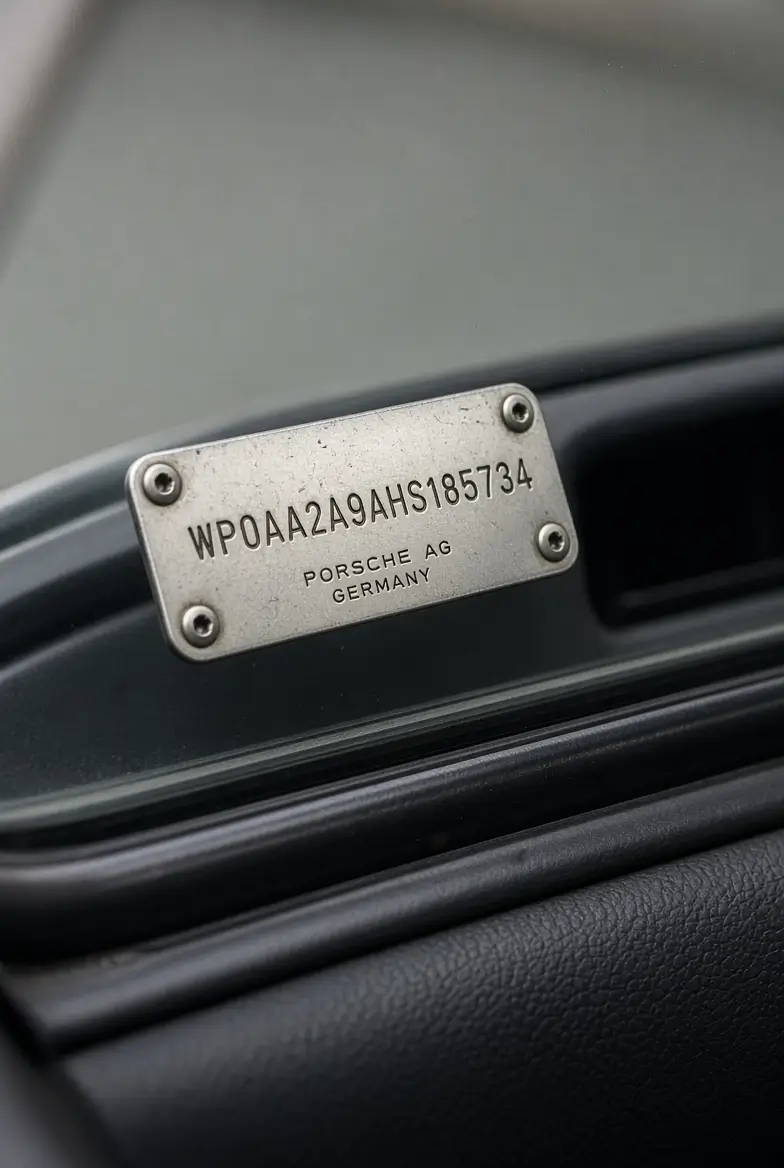
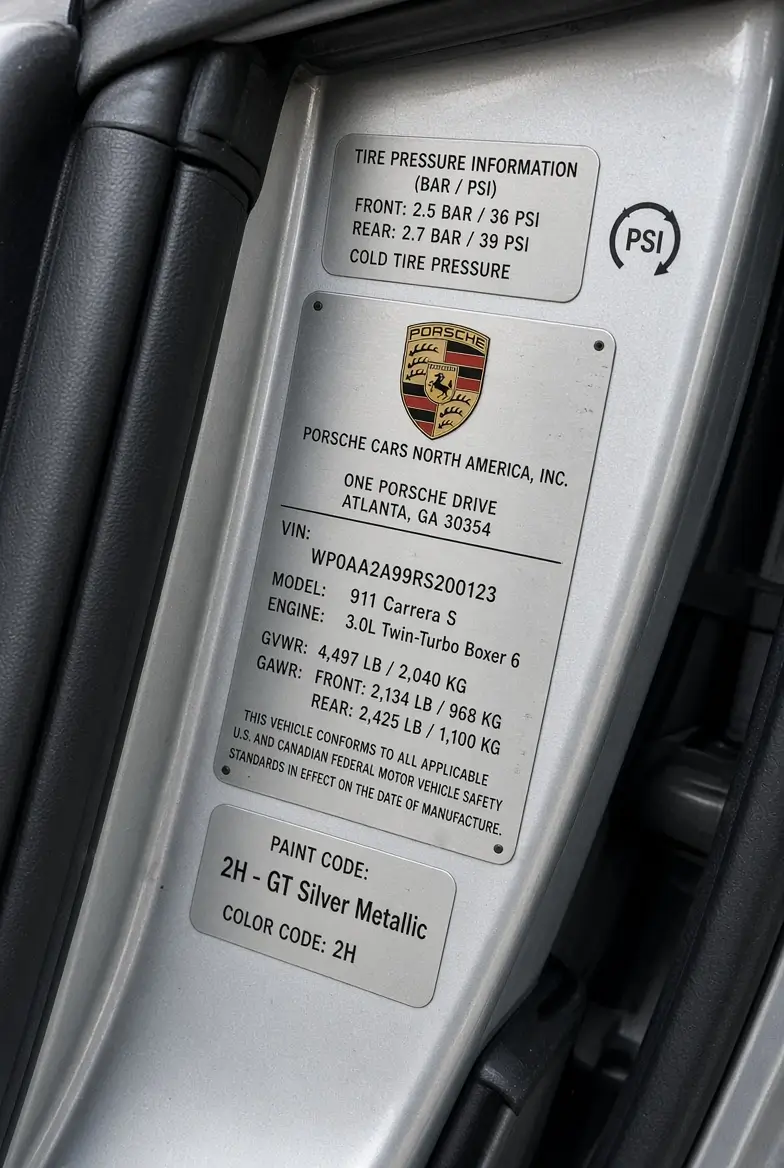
On most modern Porsches, the number is stamped on a metal plate visible through the base of the windshield, driver's side. You'll also find it on the door jamb sticker, and on older air-cooled 911s, stamped directly into the front trunk (frunk) floor or inner fender.
The chassis number also appears on the title, registration, and any factory build sheet (called a "Porsche Certificate of Authenticity" if you order one directly from Porsche).
How to Read a Porsche VIN — Breakdown by Position
Porsche follows the standard 17-character VIN format used industry-wide, with a few brand-specific quirks in the model and engine sections.
Position | Section | What It Tells You |
|---|---|---|
1–3 | WMI (World Manufacturer Identifier) | Manufacturer and plant country — WP0 or WP1 for German-built Porsches |
4–8 | VDS (Vehicle Descriptor Section) | Model line, body type, engine, transmission |
9 | Check digit | Validates the entire chassis number mathematically |
10 | Model year | Standard industry letter/number code |
11 | Plant code | Stuttgart-Zuffenhausen, Leipzig, or Bratislava (Slovakia, for Cayenne) |
12–17 | VIS (Vehicle Identifier Section) | Sequential production number |
Reading the Model Line Code
Positions 4–6 typically encode the model family — 911, Cayman, Boxster, Panamera, Cayenne, or Macan — along with body style (coupe, cabriolet, Targa). This is the section most collectors zero in on first, since it distinguishes a Carrera from a Turbo or GT3 at the chassis level, before you ever look at the options list.
WP0 vs. WP1: What the Prefix Tells You
Almost every Porsche sold new in the US carries a WP0 or WP1 prefix.
WP0 covers the sports car lineup — 911, Boxster, Cayman, Panamera — built primarily at the Zuffenhausen plant in Stuttgart, Germany.
WP1 is used for the Cayenne and Macan SUVs. Cayenne production has run through both Leipzig, Germany and Bratislava, Slovakia (in partnership with Volkswagen's Touareg platform), while Macan is built in Leipzig.
If a listing describes a 911 but the chassis number starts with WP1, something doesn't add up — that combination shouldn't exist. It's the same red-flag logic that applies when decoding a Subaru VIN or checking an Audi's chassis code: the prefix and the model on the listing have to agree.
Why Chassis Number Verification Matters More for Porsche
Porsche's used market has a wrinkle most brands don't: heavily optioned, low-production variants command a real premium, which creates an incentive for sellers to blur the line between trims. A base Carrera with aftermarket badges and wheels can be dressed up to photograph like a GTS. The chassis number, cross-referenced against a Porsche Certificate of Authenticity, is the one thing that can't be swapped with a badge kit.
There's also a track-day and modification culture around these cars that's more active than most brands — meaning a higher share of used listings have been driven hard, tracked, or rebuilt after an incident. None of that shows up in the VIN decode itself, but a chassis number that's internally inconsistent (wrong plant for the claimed model, or a check digit that doesn't validate) is often the first sign that something else is being hidden too.
What the Decode Confirms
Model line, body style, and generation
Original engine and transmission configuration
Assembly plant and country
Model year
What It Won't Confirm
Whether the car has been tracked or raced
Prior accident or bodywork history
Whether factory options (Sport Chrono, PASM, ceramic brakes) are genuinely equipped or badge-only
Odometer accuracy
For the option-level detail, order the factory build sheet directly from Porsche using the chassis number — it lists exactly what left the factory, which is the only reliable way to confirm a claimed spec.
If you're shopping in a state with a dense enthusiast resale market, run a full report through your California VIN check or Texas VIN check tool before you commit — both states see high volumes of performance-car listings, and correspondingly higher odds of undisclosed track use or accident history.
Cross-Checking a Cayenne's Tow Rating
If you're looking at a Cayenne specifically for towing a trailer, don't assume every model year carries the same rating — engine, air suspension, and factory tow package all affect it. Our guide on finding towing capacity by VIN walks through pulling that spec directly from the chassis number, and pairs well with a trailer VIN decoder if you're sourcing the trailer separately.
Frequently Asked Questions
Get answers to common questions about Porsche VIN Identification: Reading Your Chassis Number | VinSpectorAI
Uncover Complete Vehicle History Reports
Discover critical vehicle information before you buy. Our VIN decoder reveals accident records, title status, recalls, and service history to help you make informed decisions.