Audi VIN Decoder: What Your Audi's VIN Tells You (and What It Doesn't)
The listing says "2019 Audi A4, Premium Plus, quattro, loaded." Before you believe it, read the VIN. An Audi VIN decoder turns those 17 characters into the model, year, trim, engine, drivetrain and the factory that built the car, and you can check every one of them yourself in a few minutes.
We ran a real decode through NHTSA's free tool for this guide. Below you'll see exactly what it returned, what each character means, and what no VIN can tell you: the option list, the paint code, the window sticker and the car's history.

How do you decode an Audi VIN?
Read the 17 characters left to right: positions 1–3 identify the manufacturer, 4–8 describe the model, body and engine, 9 is a check digit, 10 is the model year, 11 is the assembly plant and 12–17 are the serial number. You can confirm every position for free in the NHTSA vPIC decoder, run by the US federal auto-safety agency.
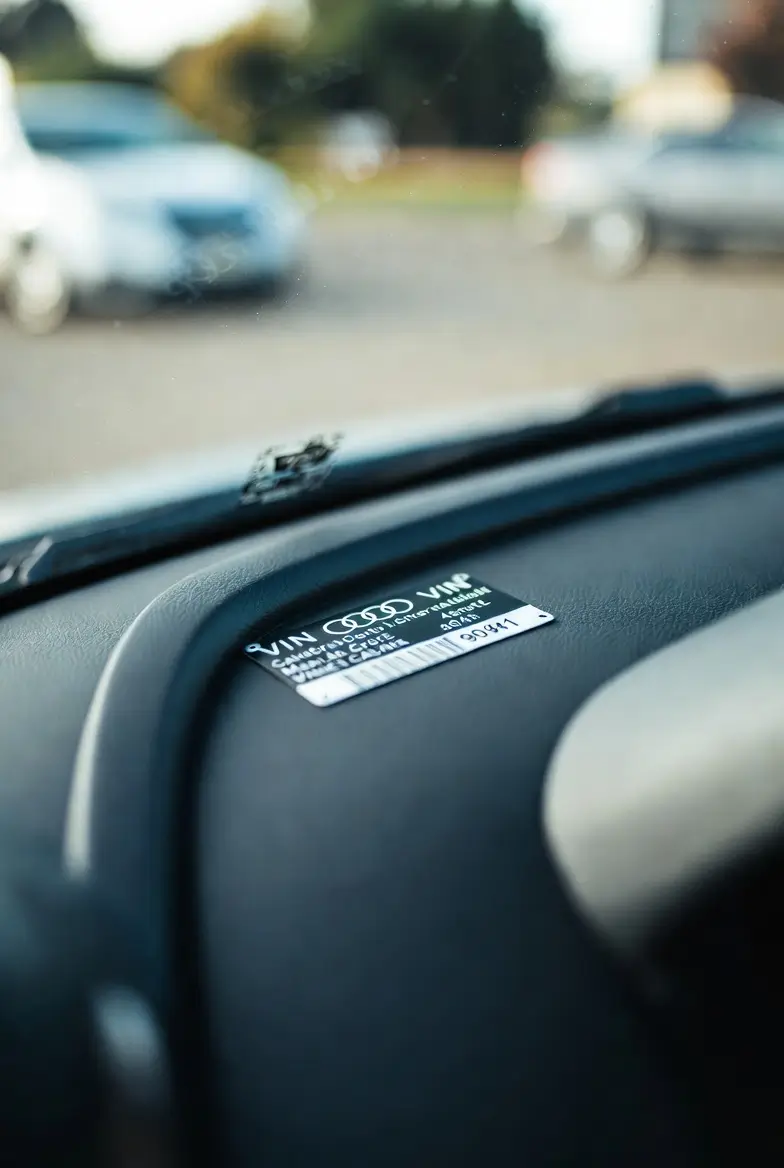
Where is the VIN on an Audi?
Look through the windshield at the base of the dashboard on the driver's side. Federal rules require the VIN to be inside the passenger compartment and readable through the glass by someone standing outside "adjacent to the left windshield pillar" (49 CFR 565.13). You'll also find it on the driver's door jamb label, the title, the registration and your insurance card.
Check that the VIN matches in at least two places on the car and on the title. If it doesn't, stop until someone can explain why.
What does an Audi VIN look like?
Here's a VIN in the format Audi uses in the US: WAUENAF42KA012345. The serial number at the end is made up for this guide, but the rest is valid. On October 1, 2026 we ran it through NHTSA vPIC, and the right-hand column shows what came back.
Position | Characters | What it means | What NHTSA vPIC returned |
|---|---|---|---|
1–3 | WAU | World Manufacturer Identifier | Make: Audi · Manufacturer: Audi AG |
4–8 | ENAF4 | Model line, body, engine, restraint system | A4 · sedan · 2.0L 4-cylinder · AWD · automatic · trim "quattro Premium Plus" |
9 | 2 | Check digit | "Check Digit (9th position) is correct" |
10 | K | Model year | 2019 |
11 | A | Assembly plant | Ingolstadt, Germany |
12–17 | 012345 | Production serial number | Unique to each car |
What do WAU, WA1 and WUA mean?
The first three characters are the World Manufacturer Identifier. We looked up each Audi prefix in NHTSA's WMI decoder: WAU and TRU are Audi AG passenger cars, WA1 is an Audi AG multipurpose vehicle (SUV), WUA is an Audi Sport GmbH passenger car and WU1 is an Audi Sport GmbH SUV. NHTSA lists Volkswagen AG as the parent company.
If the prefix doesn't fit the vehicle, ask why. An SUV, for example, should carry an SUV prefix (WA1 or WU1), not a passenger-car one.
What do positions 4–8 tell you, and what is "ZZZ"?
Characters 4 to 8 describe the model line, body, engine and restraint system. This is where a decoder earns its keep: in our test, vPIC turned "ENAF4" into A4, sedan, 2.0-liter, all-wheel drive and the trim name. For the rules that apply to every brand, see our guide on how to decode a VIN number.
Some Audi VINs show ZZZ right after WAU. We ran one, WAUZZZ8EX5A001303, through NHTSA vPIC: it still returned Audi, 2005 and Ingolstadt, but couldn't identify the model and flagged "Unused position(s): 4,5,6,7,8." A VIN like that wasn't coded for the US market, so if you see one on an Audi for sale in the US, ask for the import paperwork and check its title history before you buy.
How does the check digit work?
The 9th character is a math check computed from the rest of the VIN, as set out in the federal VIN rules (49 CFR Part 565). Change one character and it usually stops matching, which catches typos and crude fakes. Our example passed: vPIC returned "VIN decoded clean. Check Digit (9th position) is correct."
How do I find the model year from an Audi VIN?
Look at the 10th character. This is the model year set by 49 CFR 565.15, and the same codes apply to every brand.
Code | Model year | Code | Model year | Code | Model year |
|---|---|---|---|---|---|
A | 2010 | G | 2016 | N | 2022 |
B | 2011 | H | 2017 | P | 2023 |
C | 2012 | J | 2018 | R | 2024 |
D | 2013 | K | 2019 | S | 2025 |
E | 2014 | L | 2020 | T | 2026 |
F | 2015 | M | 2021 | V | 2027 |
The letters I, O and Q are never used anywhere in a VIN, and U is skipped in the year cycle.
Which plant built my Audi?
The 11th character is the plant of manufacture (49 CFR 565.15). Testing a 2019 Audi passenger-car VIN in NHTSA vPIC, we got A = Ingolstadt, N = Neckarsulm and 7 = Heilbronn in Germany, 1 = Győr in Hungary and D = Bratislava in Slovakia. Plant codes we couldn't confirm on a passenger-car VIN are left out, so run your full VIN to see your plant.
A plant that doesn't match the model and year isn't proof of anything on its own. But together with a wrong prefix or a failed check digit, it's a reason to dig deeper.
What does a free Audi VIN decoder show, and what does it miss?
When we ran our example VIN through NHTSA's free decoder, it returned the make, model, year, trim, body, engine size, drivetrain, transmission and plant, filling 58 of its 127 data fields. It returned no option list, no paint code, no accident or title history and no recall status, because none of that is part of the VIN itself.
Can my VIN tell me the model and trim?
Often, yes. Our test returned "A4" and the trim "quattro Premium Plus." Some fields came back empty, though, including the engine model and series, so if a decoder leaves something blank, use the option codes covered below to fill the gap.
Is quattro in the VIN?
Drivetrain is. Our decode returned "AWD/All-Wheel Drive" alongside the quattro trim name, which is enough to tell an all-wheel-drive car from a front-wheel-drive one.
What our Audi data shows
Across Audi models, our Audi VIN check tracks 1,086 NHTSA complaints, 177 recall campaigns and 29 crash-related complaints. In that data the A3 has the most complaints (394), while the A6 has the most recall campaigns (48). A decoder shows you none of this, because it's tied to the model and to the individual car's history, not to the VIN's structure.
How do I check my Audi's options and build sheet by VIN?
Audi records factory options as three-digit PR codes on a build sticker, with one copy in the maintenance booklet and a second near the spare-tire well in the trunk, according to Brake & Front End. For a plain-English list with original prices, get the window sticker, which Audi owners report receiving by giving the VIN to Audi USA's chat or a dealer.
How to read the PR code sticker
"All of the installed options are listed in the form of three-digit production codes called 'PR codes,'" explains Brake & Front End. Each code stands for one factory-fitted item, so a listing that promises a feature the codes don't show deserves a question.
The sticker isn't always where you'd expect. On a 2015 Q5, one owner on the Audi Owners Club forum found it "in the boot under the lower carpet by the battery tray," and the forum's moderator suggests asking a dealer for the build record if you can't find it.
How to get the Audi window sticker
Federal law requires every new car to carry a label showing its suggested retail price and the price of each factory option (15 U.S.C. § 1232). That makes the original window sticker the quickest way to check a "fully loaded" claim.
On Audizine, Audi owners reported in 2020 that Audi USA's chat emailed them the window sticker within minutes of receiving the VIN. Our window sticker by VIN guide covers other ways to get one.
How do I find my Audi's paint code?
Your Audi paint code isn't in the VIN; it's printed on a label, most often on the driver's door jamb or in the trunk near the spare tire, according to PaintScratch. Audi codes are short letter-and-number combinations such as LY9C for Ibis White, sometimes with a second part.
Why the VIN still matters for paint
PaintScratch puts it plainly: a VIN "may help identify the original paint, but it is not the paint code or formula to use when ordering." If the label is missing, our guide to finding a car's color code covers the other places to look.
How do I check Audi recalls by VIN?
Enter the VIN in NHTSA's recall lookup, which shows safety recalls from the past 15 years that haven't been repaired on that specific car. Audi USA also runs its own recall and service campaign lookup.
What a clean recall result does and doesn't mean
"0 unrepaired recalls associated with this VIN" means no open safety recall in NHTSA's data for that car. It doesn't cover recalls more than 15 years old, and it says nothing about accidents or title problems.
What can't an Audi VIN decoder tell you before you buy?
A decoder confirms what the car was when it left the factory; it can't show a salvage or flood title, a past accident, an odometer rollback or a theft record. Those sit in title, insurance and theft records, which is what a vehicle history report checks.
Cars registered in more than one state
If the Audi has been titled in several states, check records from each one, because that's how title washing hides a branded title. Buying in California or Texas? Start with that state's records, then look further back.
Run the full check before you pay
Our Audi VIN check pulls title, accident and recall records for the exact car and flags the known problems for its model and engine. The decode tells you what the car is. The history tells you what happened to it.
Before you put down a deposit
Read the VIN in two places, check the year and plant against the charts above, and match the PR codes or window sticker to what the listing promises. Then run a free check on VINspectorAI to see what happened to the car after it left the factory.
Frequently Asked Questions
Get answers to common questions about Audi VIN Decoder: What Your Audi's VIN Tells You (and What It Doesn't)
Uncover Complete Vehicle History Reports
Discover critical vehicle information before you buy. Our VIN decoder reveals accident records, title status, recalls, and service history to help you make informed decisions.