MMR Car Value: What the Manheim Market Report Actually Tells You
The dealer slides the appraisal across the desk. Eleven thousand two hundred. You ask how they got there, and they say "that's what MMR says."
You've never seen that number. You can't look it up. And you're expected to negotiate against it anyway.
MMR is real, it's the most accurate wholesale pricing data in the American car business, and it is not a number designed for you to see. Here's what it measures, why your car's value on it differs from every figure you found online, and how to use it without a dealer license.
What MMR Actually Is
The short definition
MMR stands for Manheim Market Report. It's a wholesale valuation benchmark — an estimate of what dealers are currently paying each other for a specific vehicle at auction.
That word, wholesale, does all the work in this article. MMR is not what a car sells for on a lot. It's the price before reconditioning, before warranty, before advertising, and before the dealer's margin.

Who runs it
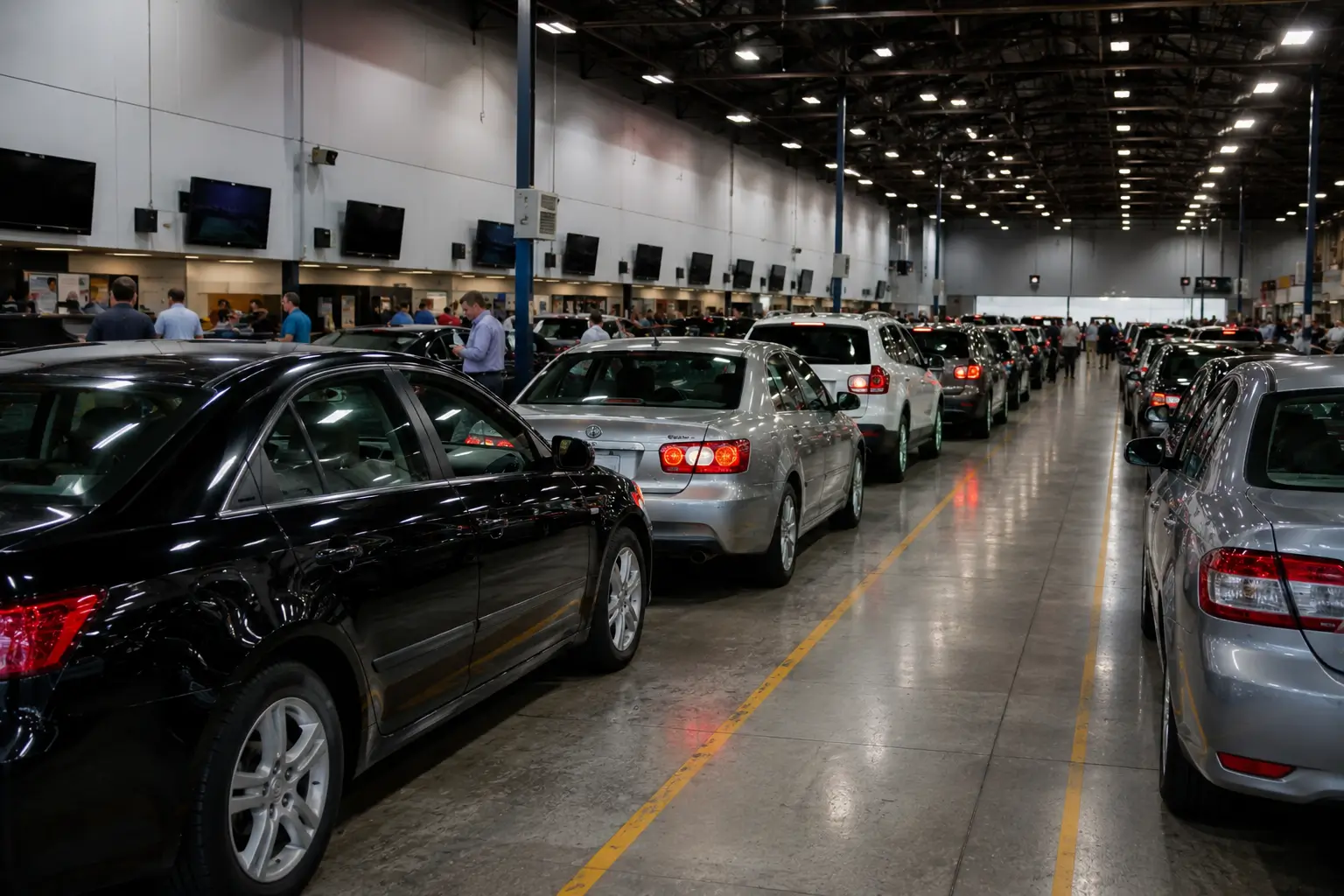
Manheim is the largest wholesale auto auction network in the United States, operating physical and digital lanes nationwide as part of Cox Automotive. Millions of vehicles pass through the network each year.
Because Manheim sees close to the entire volume of its own transactions, MMR isn't a projection built from listings or asking prices. It's built from completed sales.
Why dealers reference it constantly
For a dealer, MMR is the daily bidding ceiling and the trade-in floor at the same time. It tells them what a car should cost in the lane, and what they can afford to offer you on a trade while still making the deal work.
That's why the number turns up in your negotiation. It's the anchor the dealer is actually working from.
How the Number Is Calculated
The 13-month transaction window
MMR pricing is calculated from wholesale sales over the previous 13 months, weighted so recent transactions count more heavily. That weighting is deliberate — it lets the value follow seasonal swings and sudden market shifts rather than averaging them away.
You'll see "13 weeks" claimed on some sites. That's wrong. Manheim's own documentation specifies 13 months.
Why it refreshes nightly
New calculations run every night against the previous day's completed sales. In a market where a segment can move hundreds of dollars in a few weeks, a value refreshed quarterly would be actively misleading.
This is the single biggest structural difference between MMR and a printed guidebook.
What gets adjusted
The base value is a starting point that then flexes for the specific car:
Mileage against the average for that year and model
Geographic region — a convertible is worth more in Arizona than Michigan, and four-wheel drive reverses that
Condition grade — the largest single adjustment
Exterior color
Factory-installed options and packages — trim and equipment can separate two identical-looking cars by thousands, which is exactly what the original window sticker documents
Regional adjustment is why the same car appraises differently in California than in Illinois. It's not the dealer inventing a discount — it's the auction data reflecting genuinely different local demand.
What gets excluded
Statistical outliers are stripped out, so one bizarre sale doesn't distort the benchmark.
More importantly: Manheim does not collect retail transaction data. Retail figures shown alongside MMR are estimated markups over wholesale, not observed retail sales. Manheim itself advises consulting other sources for retail estimates — worth knowing before anyone quotes an "MMR retail value" at you as though it were measured.
Condition Grade: The Part That Moves the Number Most
How the 1.0 to 5.0 scale works
Manheim grades vehicles on a scale where 5.0 is essentially showroom condition and 1.0 is rough. Most real cars land somewhere in the middle, and the difference between adjacent grades is money.
Grade | Condition | What it typically means |
|---|---|---|
4.5–5.0 | Excellent | Near-new, no reconditioning needed, minimal wear |
3.5–4.4 | Above average | Light cosmetic wear, mechanically sound, minor recon |
2.5–3.4 | Average | Visible wear, some repairs needed, the bulk of the market |
1.5–2.4 | Below average | Significant cosmetic or mechanical work required |
1.0–1.4 | Rough | Major damage or mechanical problems |
What drops a grade
Panel damage, paint work, mismatched tires, interior wear, warning lights, and mechanical faults all pull the grade down. So does an odometer well above average for the model year.
None of this is subjective in the way it sounds — grading follows a defined inspection standard, which is why a dealer's walkaround of your trade takes longer than you'd expect.
Announcements at the lane
Separate from grade, sellers must declare specific conditions when a car runs through the auction: frame damage, structural alterations, mechanical defects, salvage history.
An announcement of that kind moves the value far more than a grade point. A branded title is not a condition problem you can polish out — it's permanent, it follows the VIN, and every future buyer sees it.
MMR vs. KBB vs. Black Book vs. Edmunds
The four numbers people confuse
Source | What it measures | Primary users | Public access |
|---|---|---|---|
MMR (Manheim) | Wholesale auction transactions | Dealers, wholesalers | No — dealer accounts only |
Kelley Blue Book | Retail and trade-in estimates | Consumers | Yes, free |
Black Book | Wholesale values | Dealers, lenders | Subscription |
Edmunds | Retail market pricing | Consumers | Yes, free |
J.D. Power (NADA) | Retail and trade-in guides | Dealers, lenders, banks | Partial |
Why retail guides and MMR disagree
They're measuring different transactions. A consumer guide estimates what a retail buyer pays a dealer. MMR measures what a dealer pays another dealer.
Both can be accurate and still differ by thousands on the same car. Neither one is lying to you.
Which number applies to your situation
Selling to a dealer or trading in: wholesale is the relevant world, so MMR is closest to reality.
Buying from a dealer: you'll pay retail, and MMR only tells you roughly what the dealer has in the car.
Selling privately: you sit between the two, which is precisely why private sales usually net more than a trade-in and take four weeks longer.
The spread, and who gets it
The gap between wholesale and retail isn't pure profit. It covers reconditioning, transport, auction fees, floor plan interest, the lot, the staff, warranty exposure, and the cars that sit unsold for ninety days.
Understanding that keeps the negotiation realistic. A dealer who offers you MMR flat on a trade is offering you the wholesale price with none of the wait — and that's a legitimate trade to consider.
Can You Look Up MMR Without a Dealer License?
The honest answer
Not directly. MMR is a subscriber tool for licensed dealers and wholesalers with Manheim accounts. There is no consumer login.
Anyone who tells you otherwise is usually selling something.
Ask the dealer to show you the screen
The most effective move costs nothing: ask to see it. Many dealers will turn the monitor around, particularly if you're a serious buyer or trading a clean car.
A dealer who quotes MMR as justification but won't show it is telling you something about the number.
Proxies that get you close
Kelley Blue Book's trade-in range and Edmunds' appraisal both approximate wholesale, usually landing within a reasonable band of MMR for mainstream vehicles.
Watching completed auction results and dealer-facing listings for your exact year, trim, and mileage gets you closer still — that's the same market MMR is measuring, just observed manually.
What not to trust
Sites offering "free MMR lookup" are not showing you Manheim data. They're showing an estimate with a borrowed name, and it's frequently worse than the free tools you already had.
Using MMR When You Buy, Sell, or Trade
Trading in
Treat MMR as the floor of a fair offer, not the offer itself. A dealer needs room, but the room should be visible and explainable rather than assumed.
Coming in with your own wholesale estimate changes the conversation from "is this fair?" to "here's what the market says."
Buying from a dealer
If you can establish roughly what the car brought at wholesale, you can see the shape of the deal — how much is reconditioning, how much is margin, and where the negotiation actually has slack.
When your car is totaled
This is where wholesale valuation stops being academic. An insurer's total-loss decision is a percentage of your car's actual cash value, and that valuation determines both whether the car gets repaired and what you're paid.
If you think the ACV is low, market data is the argument. An opinion isn't.
When the title isn't clean
A rebuilt title takes a substantial share off wholesale value permanently, and the discount doesn't disappear with a good repair. If you're establishing value for a vehicle with no clean chain of ownership at all, the appraised figure is also what sets the bond amount in a bonded title application.
Why history changes the number
Two cars, same year, same trim, same mileage, same grade. One has a clean record and one has a reported collision and a title brand from three states ago.
They are not worth the same, and the wholesale market prices that gap ruthlessly. Before you accept any valuation — yours or theirs — check what the VIN actually says.
Frequently Asked Questions
Get answers to common questions about MMR Car Value: What the Manheim Market Report Actually Tells You
Uncover Complete Vehicle History Reports
Discover critical vehicle information before you buy. Our VIN decoder reveals accident records, title status, recalls, and service history to help you make informed decisions.