
If Airbags Deploy, Is the Car Totaled? Here's What Actually Happens
Your airbags just went off. Now what?
The first question most people ask after an accident isn't about injuries — it's about the car. If the airbags deployed, does that automatically mean it's totaled? The short answer is no. But the longer answer is what you actually need to know before you talk to your insurance company.
Is a Car Totaled If the Airbags Deploy?
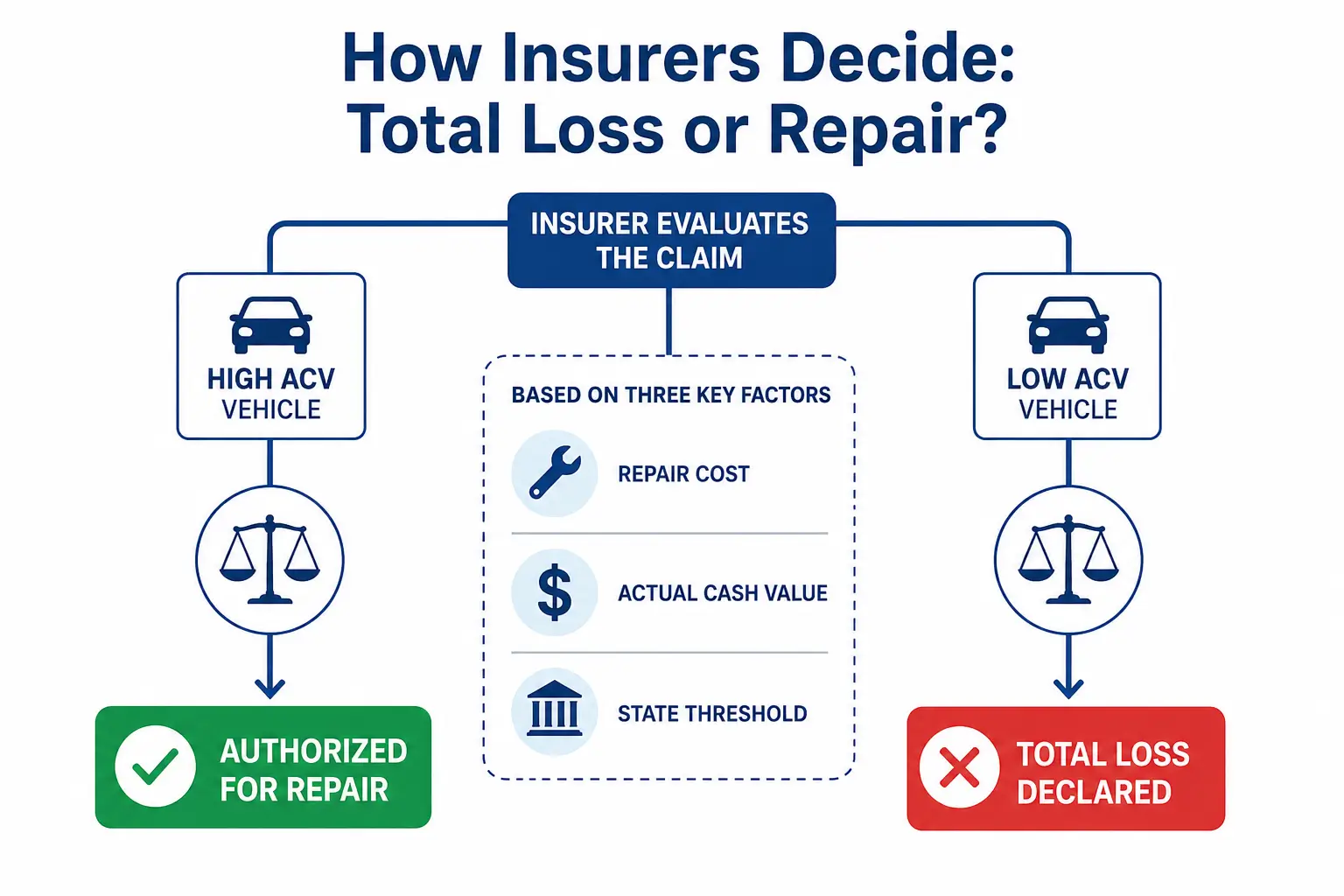
No — airbag deployment does not automatically total a car. A vehicle is declared a total loss when the cost of repairs exceeds a certain percentage of the car's actual cash value (ACV). Airbags significantly raise that repair cost, but whether the car is totaled depends on the math, not the airbags themselves.
Think of it this way: a deployed airbag is a warning that repairs will be expensive. Whether those repairs cross the total loss threshold depends on the car's value, the extent of other damage, and the state you're in.
How Insurance Companies Decide If a Car Is Totaled
The Total Loss Formula
Insurance companies use a straightforward formula: if repair costs exceed a certain percentage of the car's pre-accident value, the vehicle is declared a total loss. That percentage — called the total loss threshold — varies by state, typically ranging from 50% to 100% of ACV.
A $5,000 car in a state with a 50% threshold is totaled at $2,500 in repairs
The same car in a state with a 100% threshold needs $5,000+ in damage before it's totaled
Most states sit between 70–80%
What Adjusters Actually Look At
When an adjuster sees deployed airbags, two things immediately register: the impact was significant enough to trigger the safety system, and the repair bill is going to be high — before bodywork even starts. Specifically, they assess:
Repair cost vs. ACV — total repair estimate compared to the car's pre-accident market value
Structural damage — frame damage, crumple zones, safety system integrity
Vehicle age and mileage — older, high-mileage vehicles cross the threshold faster
State regulations — each state has specific total loss guidelines insurers must follow
Salvage value — what the wrecked car is worth if sold for parts
A salvage title is one of the most common types of branded title a car can receive.
Why Airbag Deployment Makes Totaling More Likely
Airbags are expensive to replace — and it's never just the bags. A full airbag system replacement involves:
The airbag modules themselves (driver, passenger, side curtain)
The airbag control module (SRS module)
Crash sensors throughout the vehicle
Seatbelt pretensioners
Steering wheel replacement (if driver airbag deployed)
Dashboard panels and trim
Safety system diagnostics and testing
In 2026, a full airbag system replacement can run anywhere from $3,000 to $10,000+ depending on the vehicle. For older cars with lower ACV, that repair cost alone can push the total past the threshold — even before accounting for bodywork, structural repairs, or mechanical damage.
For newer vehicles with high market value, the same repair cost may represent a fraction of the car's worth, making repair the financially logical choice.
When a Car With Deployed Airbags Is NOT Totaled
High-Value Vehicles
If a car is worth $45,000 and total repairs — including a full airbag replacement — come to $18,000, that's 40% of ACV. In most states, that's not a total loss. The insurance company will authorize repairs.
Partial Deployment
Not all airbags deploy in every accident. Side curtain airbags may deploy without front airbags, or only one side deploys. Fewer deployed bags mean lower replacement costs and a lower chance of crossing the total loss threshold.
Reset vs. Replacement
In rare cases where airbags didn't fully deploy or weren't physically damaged, a technician can clear crash codes and reset the system. This is the exception, not the rule — most modern vehicles require full replacement once airbags have deployed.
What Happens After a Car Is Totaled
If the insurance company declares a total loss, here's what follows:
You receive ACV payment — the car's pre-accident market value, minus your deductible
The lender gets paid first — if you still owe on a car loan, the payout goes toward that balance first
The title gets branded — a salvage title is issued, permanently marking the vehicle's history
You can keep the car — in most states, you can accept a reduced payout and keep the salvage vehicle, but it must be re-inspected and re-titled before it can be driven legally again
For a full breakdown of what a salvage title means for value, insurance, and resale, see our guide on [branded titles].
If you buy a car that had its airbags deployed, even if it's been repaired, that history will appear on a VIN check. The rebuilt or salvage title follows the vehicle forever — which is exactly why checking a car's VIN before any used car purchase is non-negotiable.
What to Do Immediately After Your Airbags Deploy
Step 1 — Don't Drive the Car
A vehicle with deployed airbags should not be driven until it has been inspected by a qualified professional. Beyond the airbags, there may be hidden structural damage, compromised safety systems, or sensor failures that make the car unsafe to operate.
Step 2 — Contact Your Insurance Company
Report the accident immediately. The insurer will assign an adjuster to assess the damage and determine whether to authorize repairs or declare a total loss.
Step 3 — Know Your Rights
You are not required to accept the first settlement offer. If you believe the ACV assessment is too low, you can dispute it with comparable vehicle listings, independent appraisals, or documentation of your car's condition before the accident.
Step 4 — Run a VIN Check on Any Replacement Vehicle
If your car is totaled and you start shopping for a replacement, run a VIN check on every used car you consider. Airbag deployment shows up in vehicle history reports — giving you a clear picture of what happened to that car before it ended up in a listing.
Serious accidents that deploy airbags often cause hidden engine damage that surfaces weeks later. Our guide to [common car engine problems] explains what to watch for after buying a repaired vehicle.
If you're buying in Texas, where hail and flood damage are common alongside accident histories, a Texas VIN check surfaces the full picture before you commit. The same applies in Florida, where storm-damaged and previously totaled vehicles regularly re-enter the market — a Florida VIN check is the fastest way to know what you're actually buying. And in California, one of the largest used car markets in the country, a California VIN check shows every title event, accident record, and airbag deployment in the car's history.
The Bottom Line
Airbag deployment is a serious signal — not an automatic death sentence for your car. Whether a vehicle is totaled comes down to one thing: does the cost of repairs exceed the state's total loss threshold relative to the car's value?
For older, lower-value vehicles, deployed airbags often push repairs past that line. For newer, higher-value vehicles, repairs may be authorized even after full deployment.
What doesn't change either way: the history stays with the VIN. Before buying any used car, run a check on VINspectorAI to see the full accident history, title events, and whether airbags were ever deployed — in under a minute.
Frequently Asked Questions
Get answers to common questions about If Airbags Deploy, Is the Car Totaled? Here's What Actually Happens
Uncover Complete Vehicle History Reports
Discover critical vehicle information before you buy. Our VIN decoder reveals accident records, title status, recalls, and service history to help you make informed decisions.