Common Car Engine Problems: Symptoms, Causes, and What to Do
Your engine rarely fails without warning. The knock you've been ignoring, the check engine light you keep dismissing, the rough idle you chalked up to cold weather — these are signals. And the longer you wait, the more expensive the repair.
Here are the most common car engine problems, what causes them, and how to catch them before they leave you stranded.
Why Engine Problems Are Different from Other Car Issues
Most car problems are inconvenient. Engine problems are dangerous — and expensive. A failing brake pad can be driven on for a few days. A failing engine can strand you on a highway, cause a fire, or result in a repair bill that exceeds the car's value.
The difference between a $300 fix and a $6,000 fix is often just timing. Catching engine problems early — before a minor issue cascades into catastrophic failure — is what this guide is about.
The Most Common Car Engine Problems
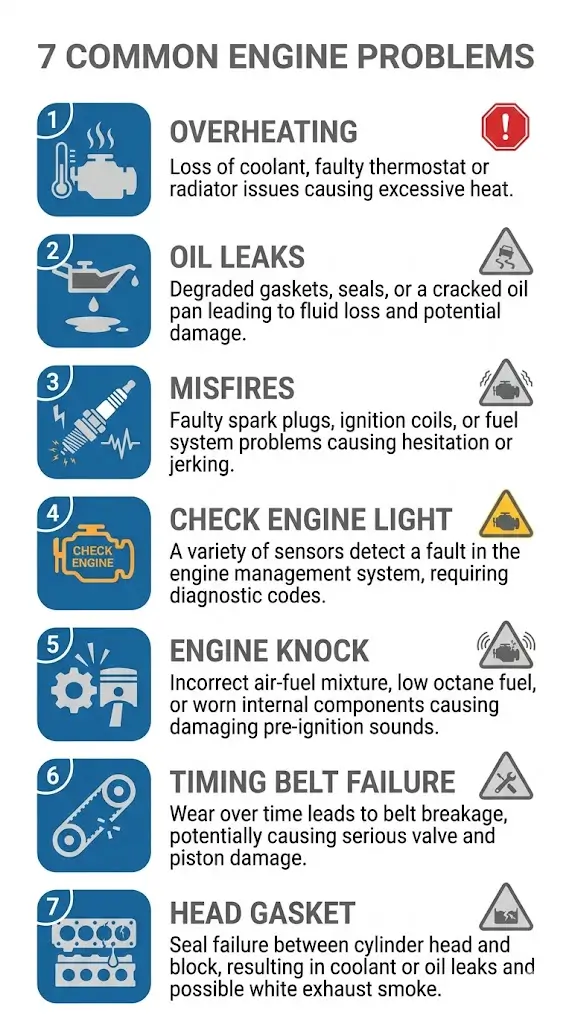
1. Overheating
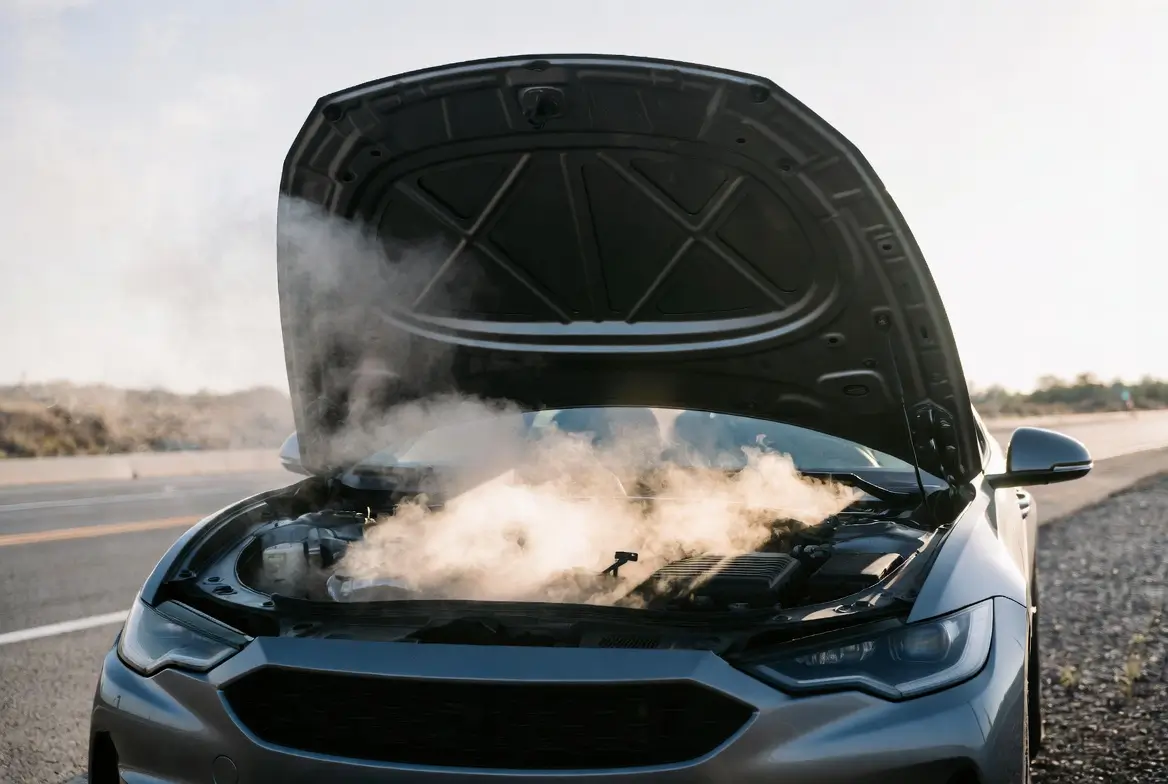
Engine overheating is one of the most common and most dangerous engine problems. When the engine runs too hot, components warp, head gaskets fail, and in severe cases the engine seizes entirely.
Common causes:
Low coolant level from a leak in the radiator, hoses, or water pump
Blocked radiator from debris or old coolant sediment
Faulty thermostat stuck in the closed position
Failed water pump not circulating coolant properly
Damaged or missing radiator cap
Warning signs: Temperature gauge climbing toward red, steam from under the hood, sweet smell of coolant, heater suddenly blowing cold air.
What to do: Pull over immediately if the temperature gauge is in the red. Do not open the hood or the radiator cap while the engine is hot. Call for assistance. Driving an overheating engine even a few extra miles can cause permanent damage.
2. Oil Leaks and Low Oil Pressure
Engine oil is what keeps metal components from grinding against each other. Low oil pressure — whether from a leak, a failing oil pump, or neglected oil changes — leads to accelerated wear and can result in complete engine failure.
Common causes:
Worn gaskets or seals (valve cover gasket, oil pan gasket)
Damaged oil pan from road debris
Failing oil pump
Clogged oil passages from sludge buildup (common in vehicles with infrequent oil changes)
Warning signs: Oil pressure warning light, oil spots under the parked car, burning oil smell, engine knocking or ticking at startup.
What to do: Check the oil level immediately. If the oil pressure warning light comes on while driving, pull over and shut off the engine. Do not continue driving with low oil pressure — bearing damage can occur within minutes.
3. Engine Misfires
A misfire happens when one or more cylinders fail to combust properly. The engine runs rough, loses power, and in some cases shakes noticeably at idle.
Common causes:
Worn or fouled spark plugs
Faulty ignition coils
Clogged or failing fuel injectors
Vacuum leaks
Low compression in one or more cylinders
Warning signs: Rough idle, hesitation or stumbling during acceleration, poor fuel economy, check engine light (misfire codes P0300-P0308 are among the most common).
What to do: A misfiring engine shouldn't be ignored — incomplete combustion sends unburned fuel into the exhaust system, which can damage the catalytic converter. Diagnostic codes from an OBD-II scanner will identify the affected cylinder.
4. Check Engine Light
The check engine light is the engine's way of telling you something is wrong. It can indicate anything from a loose gas cap to a failing catalytic converter — which is why many drivers ignore it when the car seems to drive normally.
That's a mistake. Some of the most expensive engine problems develop silently while the check engine light is on and ignored.
Common causes:
Oxygen sensor failure
Mass airflow sensor failure
Catalytic converter failure
Evaporative emission system leak (often just a loose gas cap)
Misfire codes
Exhaust gas recirculation (EGR) valve failure
What to do: A solid check engine light means get it diagnosed soon. A flashing check engine light means pull over immediately — a flashing light indicates an active misfire that can damage the catalytic converter within minutes of driving.
5. Engine Knocking
Engine knock — a rhythmic banging or pinging sound from inside the engine — is one of the most serious warning signs you can hear. It typically indicates a problem with combustion, lubrication, or internal components.
Common causes:
Low oil level or degraded oil not lubricating bearings properly
Worn rod bearings (the deep knock that gets louder with RPM)
Carbon buildup causing pre-ignition (detonation knock)
Wrong fuel octane rating
Warning signs: Knocking or pinging under load or acceleration, deepening knock that gets louder as the engine warms up.
What to do: Rod bearing knock is a serious mechanical failure — continued driving will destroy the engine. Get a professional diagnosis immediately. Don't confuse rod knock (deep, rhythmic, worsens with RPM) with lifter tick (lighter, faster, often reduces after warmup).
6. Timing Belt or Chain Failure
The timing belt or chain synchronizes the engine's camshaft and crankshaft. If it fails, the engine stops. On interference engines — which most modern engines are — a failed timing belt causes the valves and pistons to collide, resulting in catastrophic internal damage.
Common causes:
Neglected timing belt replacement interval (typically every 60,000-100,000 miles depending on manufacturer)
Oil contamination of the timing belt
Worn timing chain tensioner
Warning signs: Ticking noise from the engine, rough running, engine won't start, metal shavings in the oil.
What to do: Follow the manufacturer's timing belt replacement schedule — this is one maintenance item where prevention is everything. A timing belt replacement typically costs $500-$1,000. A bent valve repair after belt failure typically costs $2,000-$5,000 or more.
7. Head Gasket Failure
The head gasket seals the engine block and cylinder head, keeping coolant, oil, and combustion gases in their separate passages. When it fails, those fluids mix — and the results are expensive.
Common causes:
Engine overheating (the most common cause — another reason overheating must never be ignored)
Age and high mileage
Manufacturing defects in certain engines
Warning signs: White smoke from the exhaust (coolant burning), milky or foamy oil (coolant mixing with oil), persistent overheating, loss of coolant with no visible leak, bubbles in the radiator overflow.
What to do: Head gasket repairs are expensive — typically $1,500-$3,000 — but far less than an engine replacement. Continuing to drive with a blown head gasket will destroy the engine.
Car Brands with Known Engine Problems in 2026
Some engines have worse reputations than others. Current known problem areas include:
Nissan Rogue (1.5L turbo three-cylinder): Nissan issued a major recall in mid-2025 and a second one in February 2026 covering over 650,000 vehicles for engine failure risk. The variable-compression design is vulnerable to oil breakdown and bearing seizure. Nissan extended the powertrain warranty to 10 years/120,000 miles for affected US vehicles.
Jeep Wrangler and Grand Cherokee (2.0L turbo four-cylinder): A late 2025 recall covered approximately 100,000 vehicles for catastrophic engine failure and fire risk. Owners have also reported head gasket failures, oil leaks, and turbocharger failures.
Hyundai and Kia (2.0L Theta II): A long-running engine seizure problem that has resulted in multiple recalls and class action lawsuits. Affects numerous models across both brands.
Repeated engine defects that can't be fixed may qualify the vehicle under lemon law — see our guide on [what is a lemon car] to understand your rights.
Volkswagen and Audi (EA888 2.0L turbo): Known for oil consumption, timing chain tensioner issues, and turbocharger failures on higher-mileage examples.
If you're buying a used car with any of these powertrains, check the full NHTSA complaint and recall history for the specific model before purchase. You can see complaint breakdowns by year for the Toyota 4Runner, Chevrolet Spark, and dozens of other models directly on VINspectorAI's reliability pages.
How to Check a Used Car's Engine History Before You Buy
Engine problems have a history — and that history is tied to the VIN. Before buying any used car:
Check for open recalls on the NHTSA database using the VIN
Run a full VIN check to see accident history that may have caused hidden engine damage
Look for patterns in NHTSA complaints for the specific model year you're considering
In Ohio, where older used vehicles with high mileage are common in the market, an Ohio VIN check gives you the full accident and title history that can indicate whether the engine has been through major incidents. In Michigan, home to a large used car market and vehicles that have lived through harsh winter conditions, a Michigan VIN check surfaces any recorded damage before you commit. And in New York, where flood-damaged vehicles from coastal storms periodically re-enter the market, a New York VIN check confirms the car's history matches what the seller is telling you.
If the accident was serious enough to deploy the airbags, the engine may have sustained hidden damage — our guide on [airbag deployment and total loss] explains what to look for.
Engine problems that were repaired after an accident may not be visible on inspection — but they'll show up in the vehicle's history.
What Should You Do Before Buying Any Used Car?
Never buy a used car without checking its history. Engine repairs are expensive enough on cars you own — they're catastrophic on cars you just bought.
Run a VIN check on VINspectorAI before any used car purchase. See the full accident history, open recalls, title events, and NHTSA complaint data in under a minute — so you know exactly what engine history you're buying.
Frequently Asked Questions
Get answers to common questions about Common Car Engine Problems: Symptoms, Causes, and What to Do
Uncover Complete Vehicle History Reports
Discover critical vehicle information before you buy. Our VIN decoder reveals accident records, title status, recalls, and service history to help you make informed decisions.