Free VIN check
$0
No card, no signup
VIN decode, recalls for the model, and how many damage and auction records exist for this car.No title, accident or odometer history.
Carfax vs AutoCheck
They cover the same core records but get some of their data from different places. Here's how they differ, and how to decide without paying for both.
Neither one wins everywhere. Carfax is strongest on service and maintenance records. AutoCheck, which is run by Experian, gives each car an AutoCheck Score that shows whether it's below, within or above the range for similar vehicles, and draws on auction records. Both only show what was reported, so for an expensive car many buyers run both. For a cheaper first look, our full report covers title, damage, odometer and owners for $12.95 and adds an AI verdict.
Check the car you're looking at
Free: VIN decode, the model's recalls, and a count of damage and auction records.
Free check · Full report $12.95 · 5 reports $40.95
The core records overlap. The extras are where they differ.
| Carfax | AutoCheck | VinSpectorAI | |
|---|---|---|---|
| Run by | Carfax | Experian | VinSpectorAI, with NMVTIS data from a licensed provider |
| Title brands | Yes | Yes | Yes, where reported |
| Accidents and damage | Yes | Yes, including damage records from auctions | Yes, where reported |
| Odometer | Yes | Yes, plus an odometer sequence check | Yes, with rollback and frozen-odometer flags |
| Owners | Yes | Yes, with the year and state of each purchase | Yes, with the registration timeline |
| Service records | Its strongest area | Service and repair check | Not a focus |
| Overall rating | No overall score | AutoCheck Score vs similar vehicles | AI verdict (buy, negotiate or walk away) and a risk score out of 100 |
| Buyback | Buyback Guarantee, conditions apply | Buyback protection for certain title brands | No |
| Price for one report | Costs more | Costs more | $12.95 |
AutoCheck details are from Experian's own description of the report. Checked November 2026. Every report only shows what was reported to its provider.
Carfax and AutoCheck collect records from many of the same places, such as state title offices, insurers, auctions and repair shops, but not all of the same ones. That's why one report can show an accident or an auction sale the other one missed.
The title data underneath is shared. NMVTIS, the federal title database run through the U.S. Department of Justice, holds five key facts for each car: its current title state and date, its title brands, the odometer reading, and any total-loss or salvage history. Approved providers, including our data provider, use it. Repair histories aren't part of NMVTIS.
Neither is complete. Each shows only what was reported to it, and repairs paid in cash, or crashes that never involved insurance, often aren't reported anywhere. The FTC's advice applies to both: a history report “may list accidents and flood damage, but typically it will not list mechanical problems,” and it “is not a substitute for an independent vehicle inspection.”
So the better question is which gaps you can live with. Service history matters most? Carfax. Car came through an auction or a fleet? AutoCheck. Want the main risks covered for less? Start with a cheaper full report and spend the difference on an inspection.
No. Experian, the credit bureau, runs AutoCheck. Carfax is a separate company. They're competitors, and their reports are built from different mixes of records.
Run the free check first. If the car is worth pursuing, the full report is $12.95, or five for $40.95.
Free VIN check
$0
No card, no signup
VIN decode, recalls for the model, and how many damage and auction records exist for this car.No title, accident or odometer history.
Quick Check
$4.50
One car, one-time
A buy, negotiate or walk-away verdict, a risk score, the model's recalls and complaints, a target price and a negotiation script.No accident, title or odometer history.
See Quick CheckFull history report
$12.95
One-time, no subscription
Title brands, accident and damage records, odometer readings, owners, liens, auction history and Black Book value where reported, plus an AI verdict and a target price.
5 full reports
$40.95
$8.19 a report · valid 90 days
Everything in the full report, for up to five cars. For when you're comparing a shortlist.
Get 5 reportsPrices in US dollars. Full reports are ready in seconds. Carfax and AutoCheck cost more.
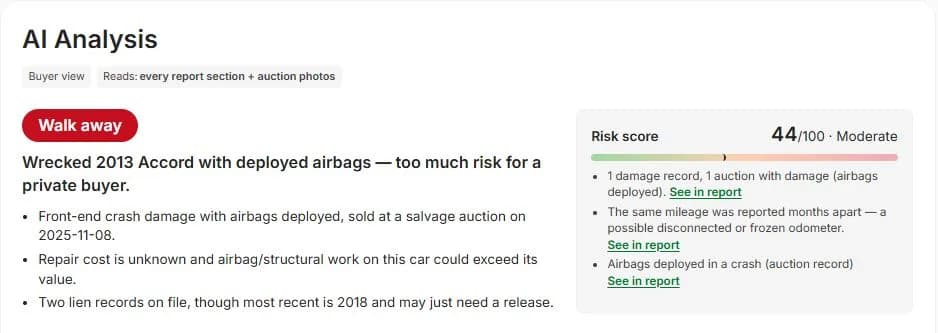
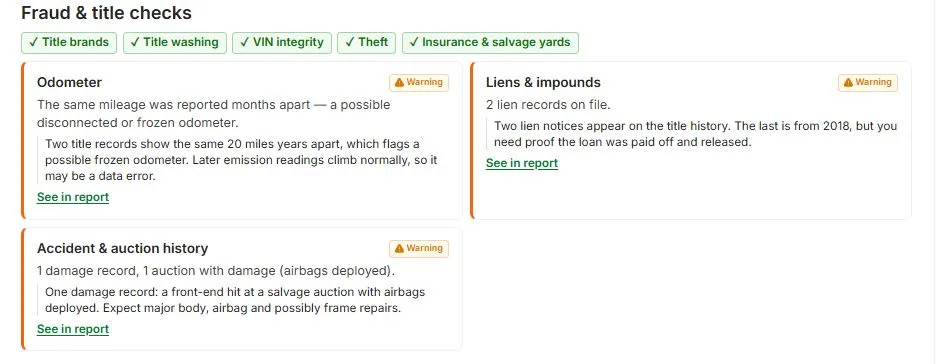
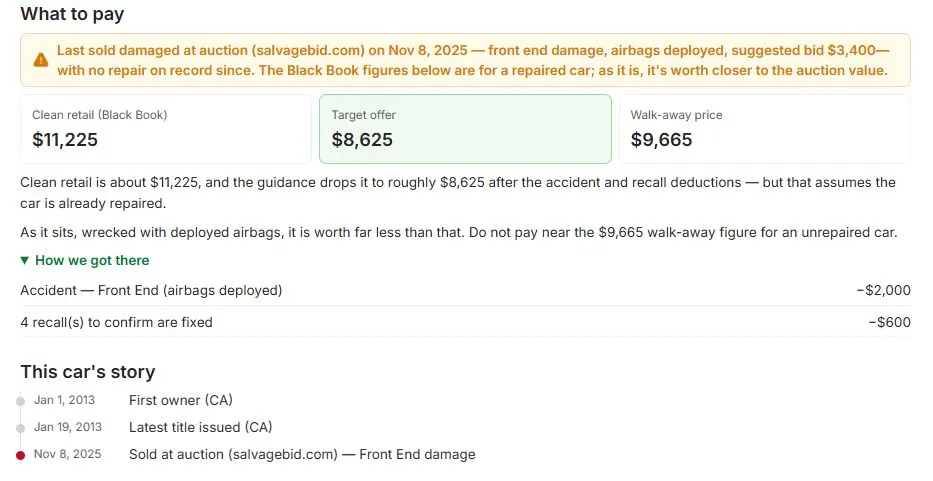
Real sections from a full report on a 2013 Honda Accord sold at a salvage auction: the verdict, the title check and the price to pay.
For title brands, accidents, odometer and owners, both are solid and both miss what was never reported. AutoCheck adds a score and draws on auction records; Carfax has more service history. Which is better depends on the car.
Neither is complete, and each sometimes shows records the other missed. If the car is expensive, run more than one report and get an independent inspection.
No. Experian runs AutoCheck; Carfax is a separate company.
Experian's one-number summary of a car's history, shown against a range for similar vehicles. A score below the range means this car's history looks worse than comparable cars.
Both. Many dealers buy one or the other for their stock and link it free on their listings. AutoCheck is popular with dealers who buy at auction.
Yes. Our full history report is $12.95, and five are $40.95. It covers title brands, damage, odometer and owners where they were reported, and adds an AI verdict and a target price.
Start with the free check. If the car is worth pursuing, the full report is $12.95 and ready in seconds. Get an independent inspection too.
Carfax is a registered trademark of CARFAX, Inc. AutoCheck is a registered trademark of Experian. VinSpectorAI isn't affiliated with or endorsed by either. Details about other companies were checked in November 2026 and may change.