Free Hawaii VIN Check — Get Your Vehicle History in 60 Seconds
Need a free VIN check for recalls? Start here. Then, get AI-powered vehicle history reports in 60 seconds, covering Hawaii DMV records, storm damage, coastal flooding, volcanic ash exposure, and theft history—all in one comprehensive report.

- Title & odometer historyBrands, salvage, washing flags
- Accidents & damageReported collisions and severity
- HI DMV-sourced dataState registration & title records
- Instant digital reportResults in seconds, no waiting
Hawaii Vehicle History & VIN Verification Services
We pull data from Hawaii DMV, NMVTIS, storm damage archives, coastal flood databases, volcanic activity logs, insurance claims, military auctions, and inter-island shipping records to give you the most complete vehicle history available for Hawaii cars. While a 'free VIN check report' might offer basic info, our service goes far beyond, focusing on the unique risks of island vehicles.
VIN-based history reports
Search using the 17-digit Vehicle Identification Number found on your dashboard or door frame. Reports include:
- Accident records from Hawaii police reports and insurance databases
- Hawaii DMV title status: clean, salvage, rebuilt, flood, or lemon law buyback
- Storm damage verification from Lane, Olivia, Iselle, and Iniki
- Coastal flood history including tsunami events from 1946, 1960, and 2011
- Volcanic ash exposure from Kilauea eruptions and lava zones
- Complete ownership timeline with inter-island transfer records
- Odometer readings with rollback detection algorithms
- Open safety recalls from NHTSA database
- Current market value based on Hawaii island-specific pricing
Tip: use our vehicle inspection checklist when examining a vehicle in person.
Hawaii-specific considerations
Storm Damage Happens More Often Than Dealers Admit: Lane dumped 50+ inches of rain on Hilo in 2018. Olivia flooded Maui and windward Oahu the same year. Lots of these storm-damaged cars got quick repairs and resold without proper disclosure. Our VIN check searches insurance claims from major weather events to flag vehicles that might've been caught in flooding or wind damage.
Coastal Flooding Leaves Problems That Show Up Later: Saltwater from storm surge or tsunami events causes electrical gremlins and corrosion that can take 6-12 months to appear. We cross-reference NOAA flood data with insurance claims to catch vehicles that were submerged—even if the title looks clean now.
Volcanic Ash Destroys Engines Fast: The 2018 Kilauea eruption in lower Puna damaged hundreds of vehicles with ash and acid rain. Ash clogs air filters, scratches cylinders, and ruins paint. If you're buying a Big Island car, check whether it was registered in Puna or Volcano Village during eruptions—our report flags these automatically.
Salt Air Corrodes Everything Eventually: Cars parked near beaches face accelerated rust in brake lines, exhaust systems, and body panels. We check registration history to see if the vehicle spent time in high-salt coastal areas and flag maintenance records showing salt damage repairs. This stuff isn't visible during test drives but costs thousands to fix.
Popular Hawaii VIN Checks
Hawaii Vehicle Safety Snapshot
Hawaii has 1,300,000 registered vehicles (FHWA), 101 traffic fatalities (NHTSA FARS), and 4,500 reported vehicle thefts (NICB) according to the latest available government data. Running a VIN check before any Hawaii private-party purchase helps verify title status, open recalls, and prior accident history for any of these vehicles.
Sources: FHWA Table MV-1, NHTSA FARS, NICB
1,300,000
Registered vehicles
FHWA
101
Traffic fatalities
NHTSA FARS
4,500
Vehicle thefts
NICB
1981–present
VIN coverage
All makes & models
Hawaii regional risk: Standard regional risk. When buying a used vehicle in Hawaii, check for weather-related damage that may not appear in standard reports.
NHTSA Recall Count — Most Popular Hawaii Vehicles
Active NHTSA recall campaigns for vehicles most commonly registered in Hawaii. Always verify recall status before buying.
| Vehicle | Model Year | Active Recalls | Check Your VIN |
|---|---|---|---|
| Toyota RAV4 | 2024 | 0 | View safety data |
| Ford F-150 | 2024 | 0 | View safety data |
| Toyota CAMRY | 2024 | 1 | View safety data |
| Honda CR-V | 2024 | 0 | View safety data |
| Toyota TACOMA | 2024 | 0 | View safety data |
Recall data sourced from NHTSA. Counts reflect campaigns for the most recent available model year. Run a VIN check below to see recall status for a specific vehicle.
Check any Hawaii vehicle in 30 seconds
Accidents · Title fraud · Odometer rollback · Open recalls · AI verdict
How to check a VIN in Hawaii — step by step
Quick 3-step process — free, and no signup required:
Enter Your VIN or License Plate
Type the 17-digit VIN from the dashboard, or just use the Hawaii license plate number if that's what you have.
We Search 15+ Databases Instantly
Our AI scans Hawaii DMV records, storm damage logs, coastal flood archives, volcanic activity reports, military auctions, shipping records, and insurance claims—all in real time.
Download Your Report Immediately
Get your results in under a minute. Download the PDF, access it from any device, and re-download anytime within 30 days.
We search Hawaii DMV records, NMVTIS, storm damage databases, coastal flood archives, volcanic activity logs, salt corrosion indicators, military auction histories, and inter-island shipping records.
How it works
From VIN to verdict in three steps
Your free VIN check gives you the basics instantly — recall count, accident count, MSRP, and core specs, no forms or phone number required. Step up to a Premium Report and the AI breaks down every category below: full accident and title history, odometer verification, ownership timeline, and real market value, explained like a mechanic friend would. Browse real sections from a real Premium Report below, or switch to the AI analysis view.
Explore a live demo report & car comparison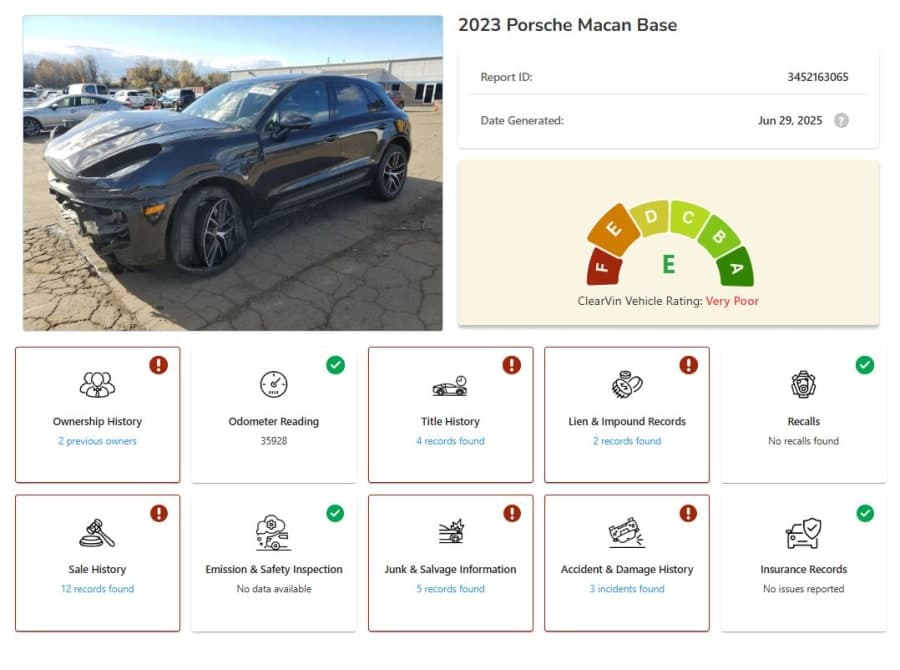
What does a complete VinSpectorAI report actually look like?
Vehicle details, a ClearVIN score, photos, and every category below — all in one scrollable free VIN check report, no PDF download required.
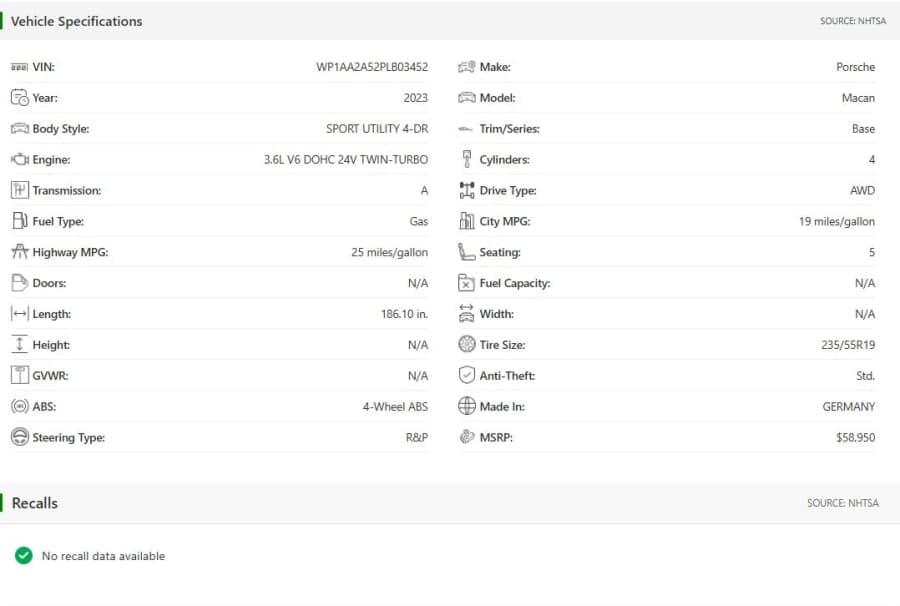
Is this exact VIN under an open safety recall right now?
We pull every open NHTSA recall for this VIN, plus full factory specs — engine, trim, drivetrain, and more.
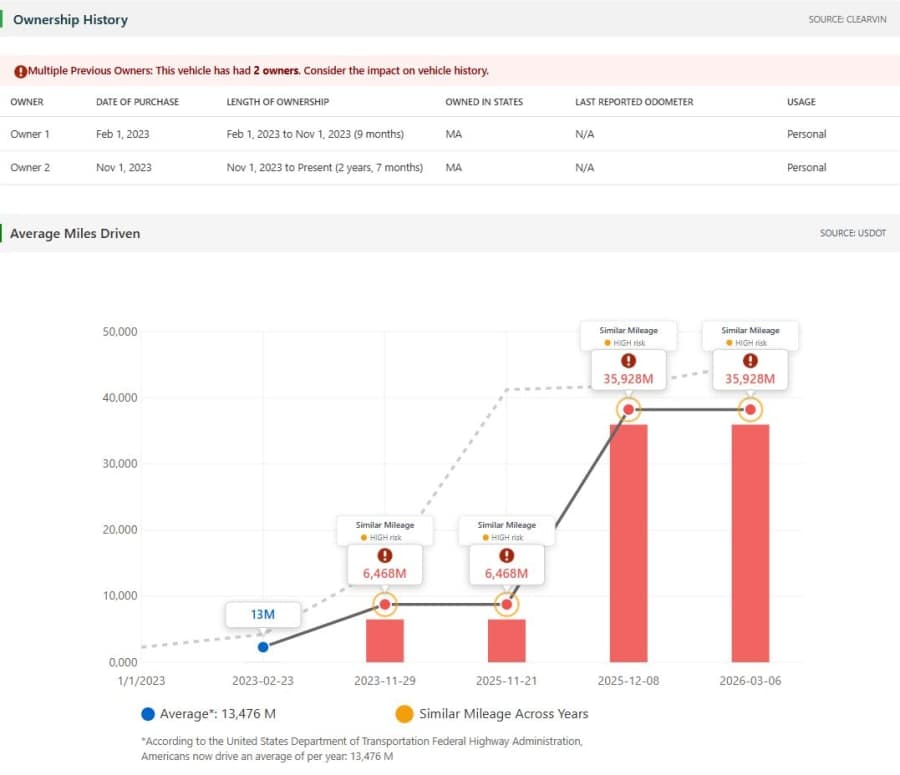
How many people have owned this car, and for how long each?
See exactly how many owners, where they were located, and how many miles each one put on the car per year.
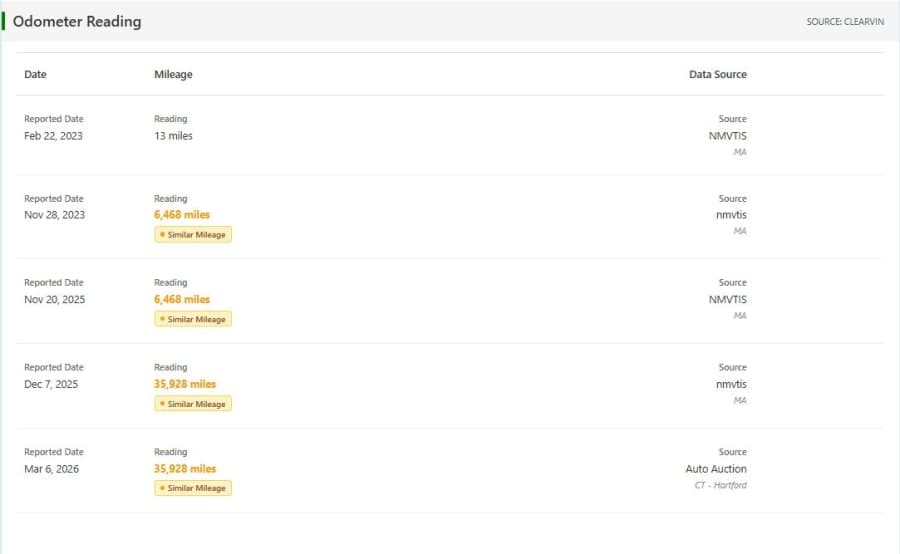
Does the mileage on the odometer match every reading on record?
We line up every recorded odometer reading and flag any reading that's lower than a previous one — a classic rollback red flag.
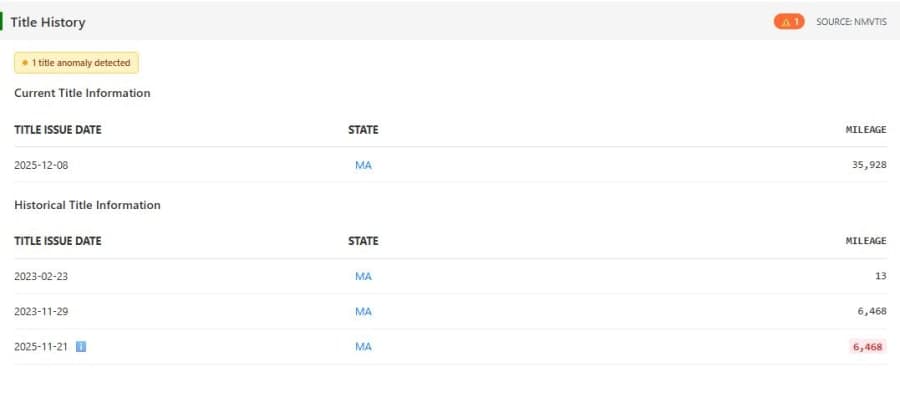
Has this title ever been transferred, retitled, or re-issued?
Every title issue, transfer, and state change is laid out in order, so you can spot a title that's been hopping state lines.

Did this car pass its last emissions and safety inspection?
State inspection results show whether the car has consistently passed safety and emissions checks — or been patched up to pass.

Has an insurance company ever filed a claim against this VIN?
Insurance claim records reveal accidents and damage that might never show up in a basic VIN check.
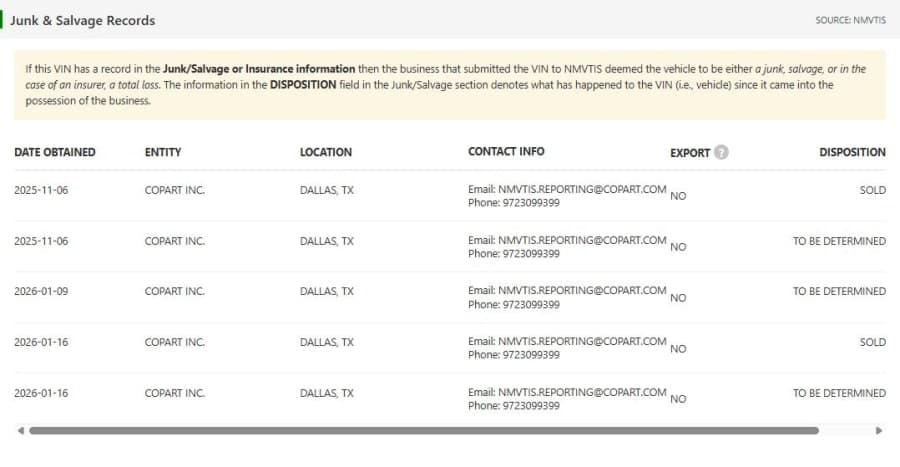
Was this car ever declared a total loss or sold for parts?
If a junk or salvage title was ever issued, it shows up here — along with the date and the state that issued it.
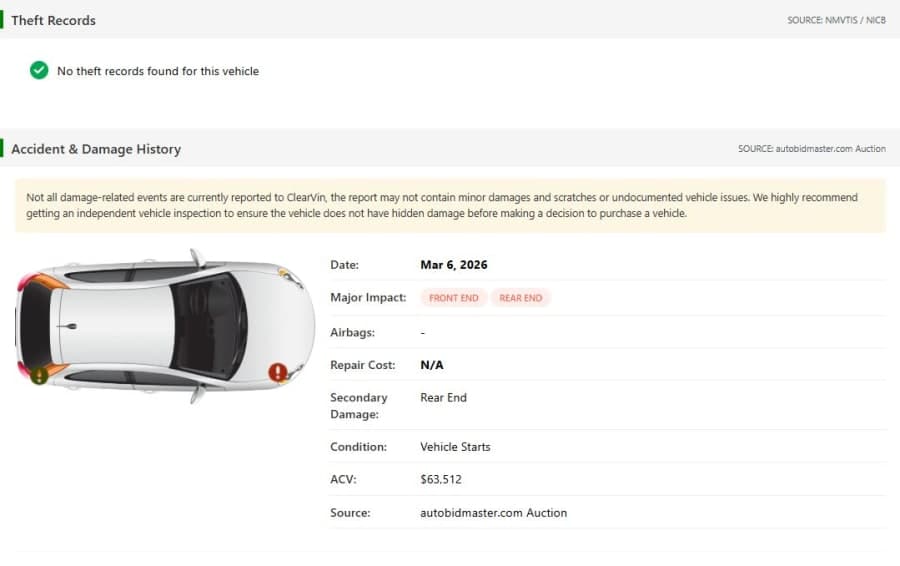
What does the accident and damage history actually say happened?
Severity, point of impact, and airbag deployment for every recorded accident — not just a yes/no flag.
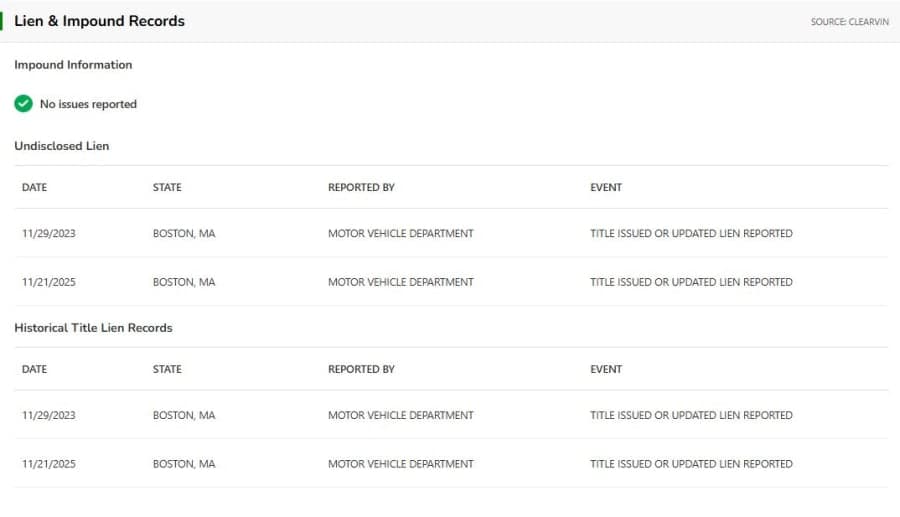
Is there a lien on this title, or has it ever been impounded?
An active lien can mean the car isn't actually free to sell — we surface lien and impound records clearly.
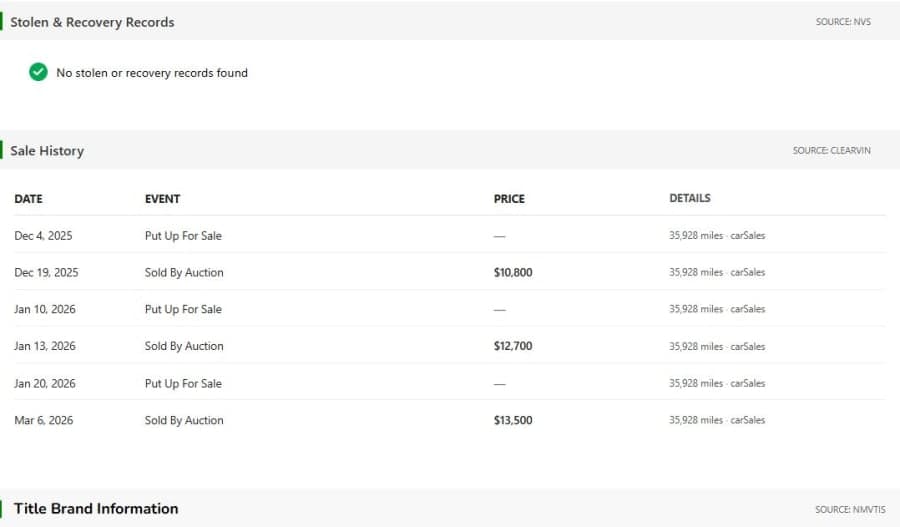
Has this VIN ever been reported stolen — and was it recovered?
Theft and recovery records show if this VIN was ever reported stolen, and what happened after it was found.
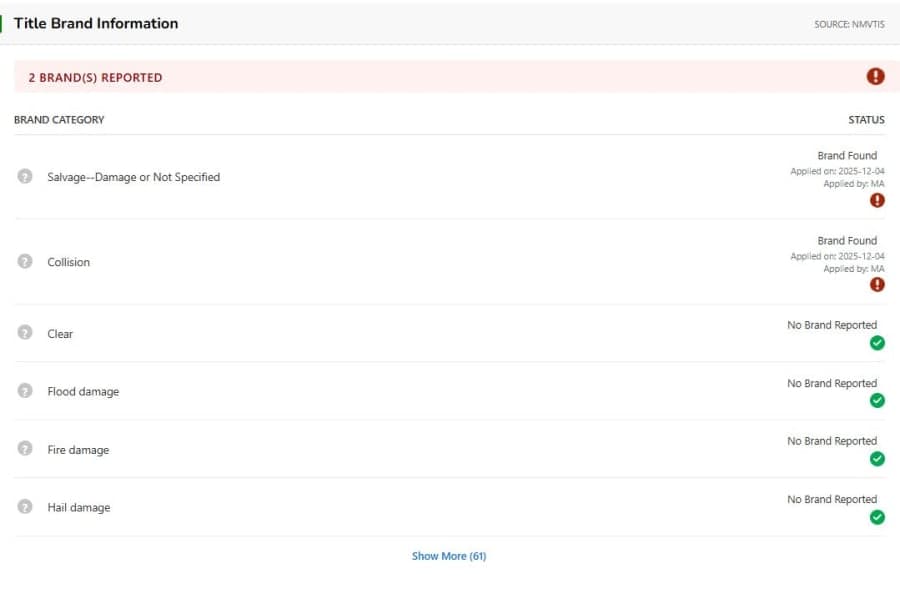
Does this title carry a brand like rebuilt, flood, or lemon?
Rebuilt, flood, lemon, or salvage — we decode every title brand and explain what it means for financing and resale.
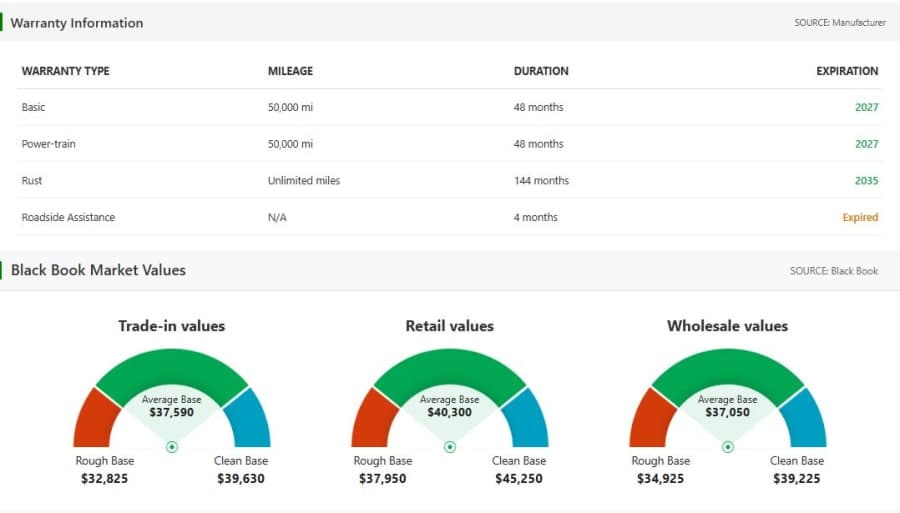
What's this car actually worth, based on real sale data?
BlackBook retail value, depreciation curve, and remaining warranty status, compared against what this car is listed for.

Has this car been listed — and relisted — on eBay before?
Past eBay listings show if this car has been shopped around before — and whether it sold or kept getting relisted.
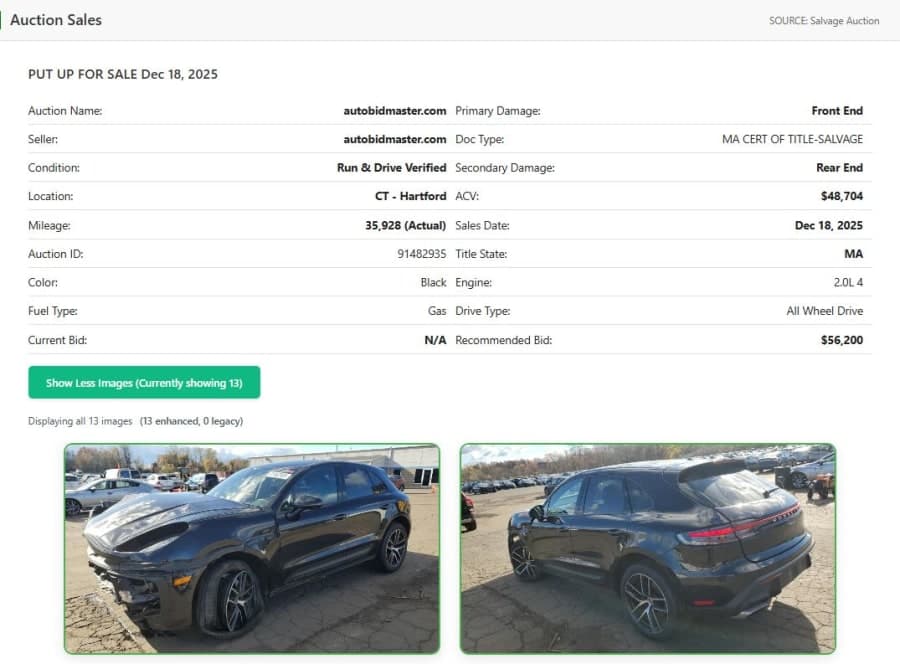
What did this car sell for at past dealer auctions?
Dealer auction sale prices give you a real-world floor for what this car is actually worth before markup.
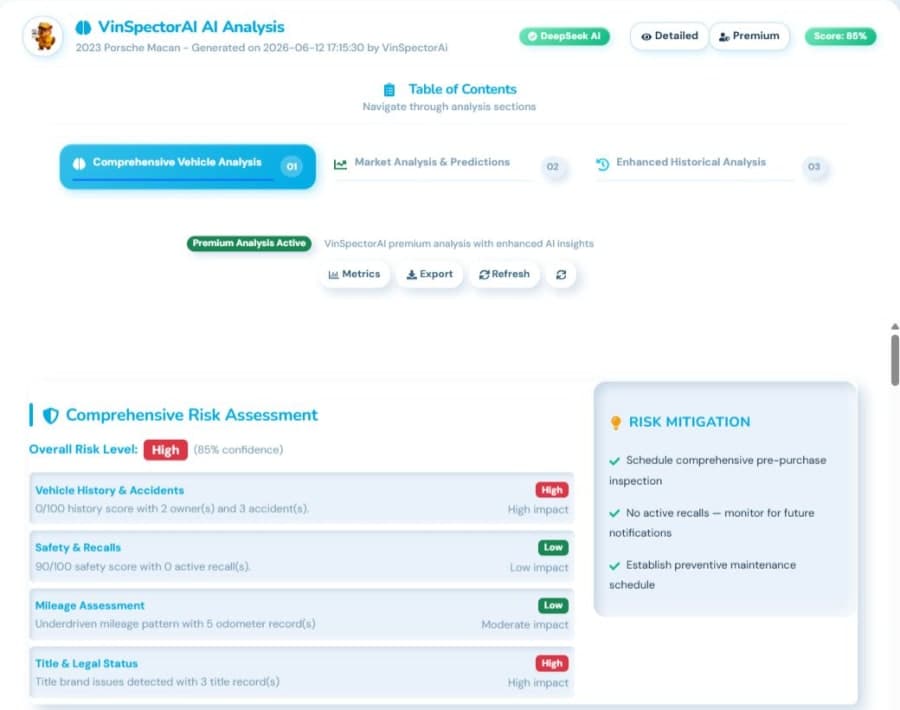
What's the AI's bottom-line read on this car, in plain English?
Our AI reads every section of the report and gives you a plain-English summary — the big picture before you dig into the details.
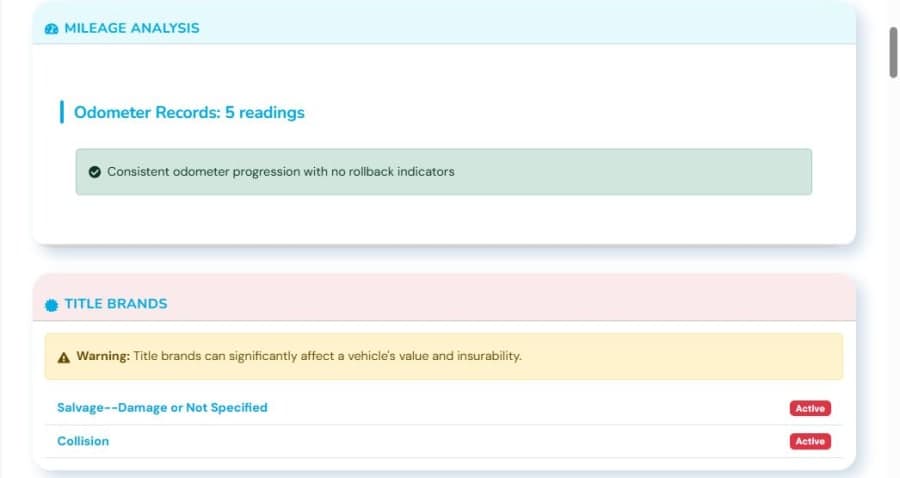
Do the mileage records and title brands actually line up?
The AI cross-checks every odometer reading against the title brand history and flags any mismatch that could signal a rollback or hidden rebuild.
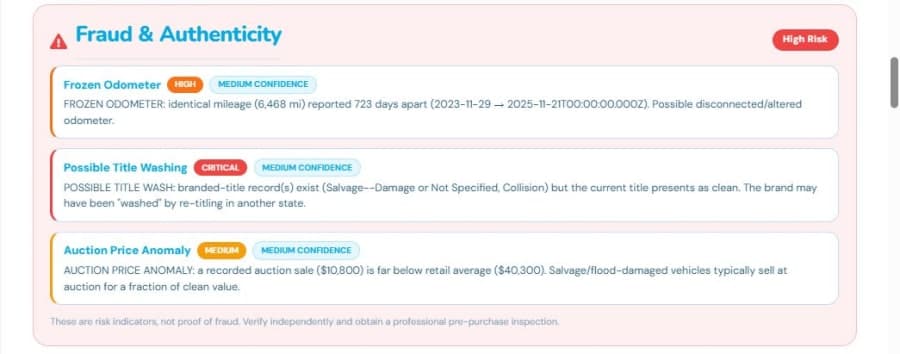
Are there any signs this VIN has been cloned or tampered with?
AI-powered checks compare this VIN against known cloning patterns and flag inconsistencies between records that point to fraud.
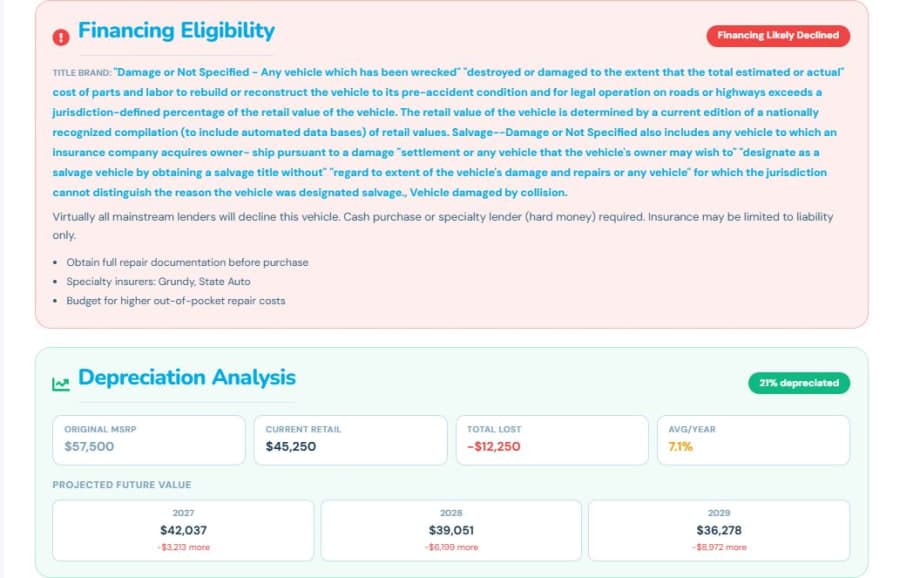
Will lenders finance this car, or could the title hold things up?
The AI flags title brands, liens, and history issues that commonly cause lenders to deny financing — before you waste time at the bank.
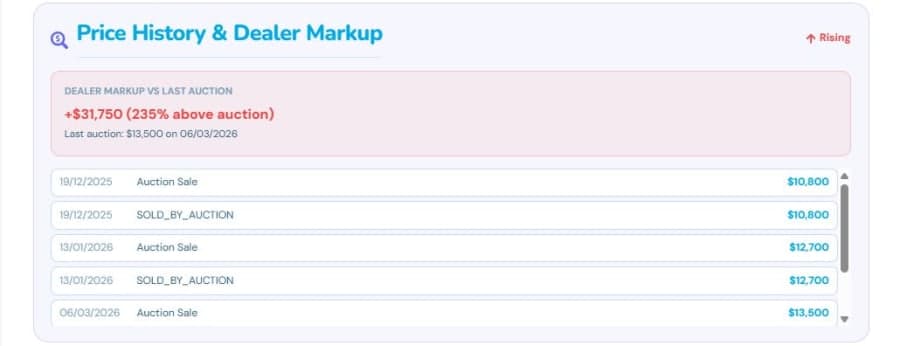
Is the asking price fair, or is the dealer adding a hidden markup?
We compare the listing price against this VIN's price history and similar sales to show you exactly how much markup you're being asked to pay.
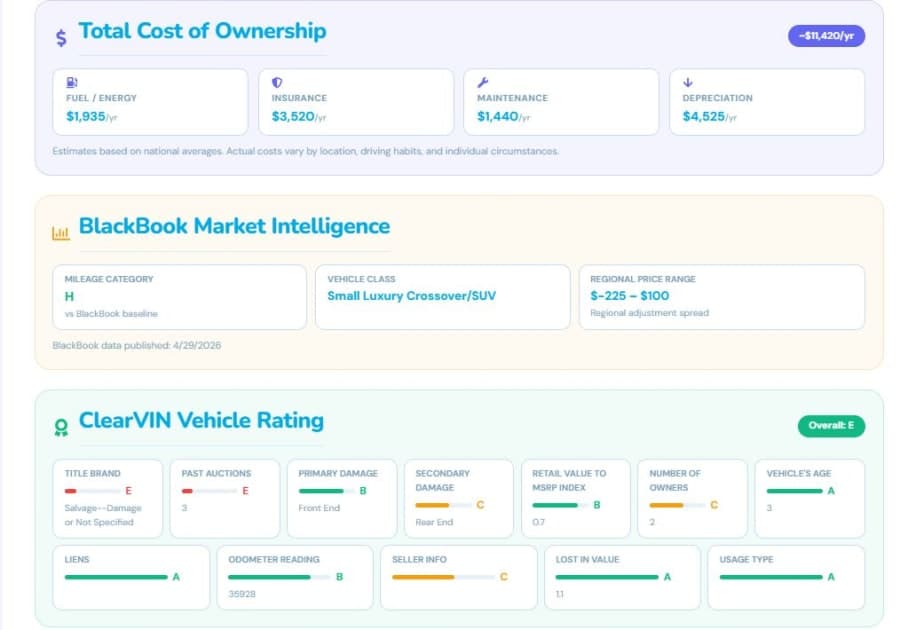
What does Black Book say this car is really worth right now?
Black Book market intelligence gives you a real, data-backed valuation — not just a guess — so you know your negotiating range.
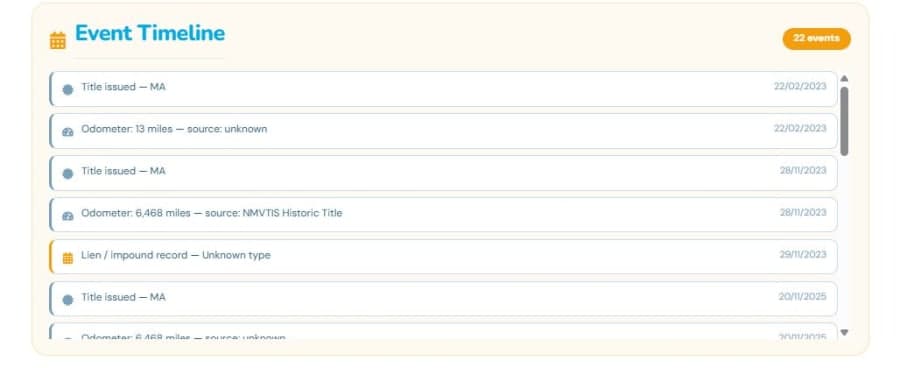
Can I see every event in this car's life laid out in order?
Every accident, title change, ownership transfer, and inspection is plotted on a single timeline, so the whole story makes sense at a glance.
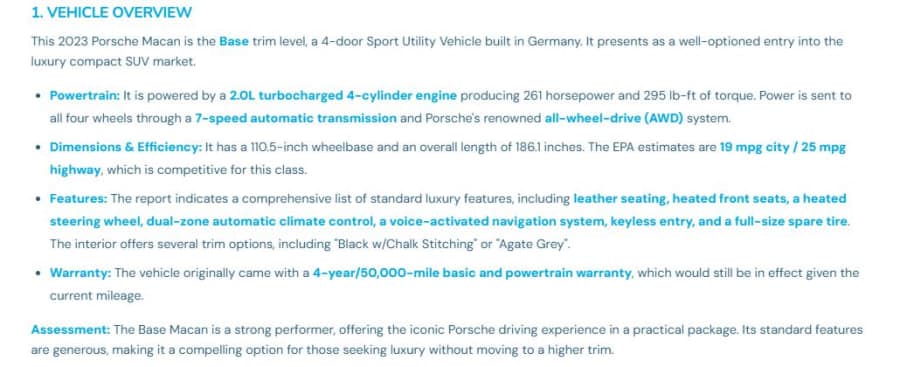
What's the AI's quick snapshot of this exact vehicle?
Year, make, model, trim, and the key facts that matter — summarized by the AI before you dive into the deeper analysis.
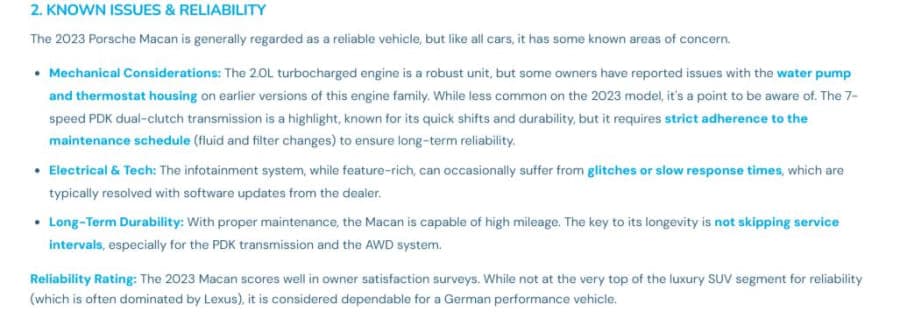
What problems are common for this exact year, make, and model?
The AI flags known recalls, common failure points, and complaints reported for this specific model year — so you know what to inspect.
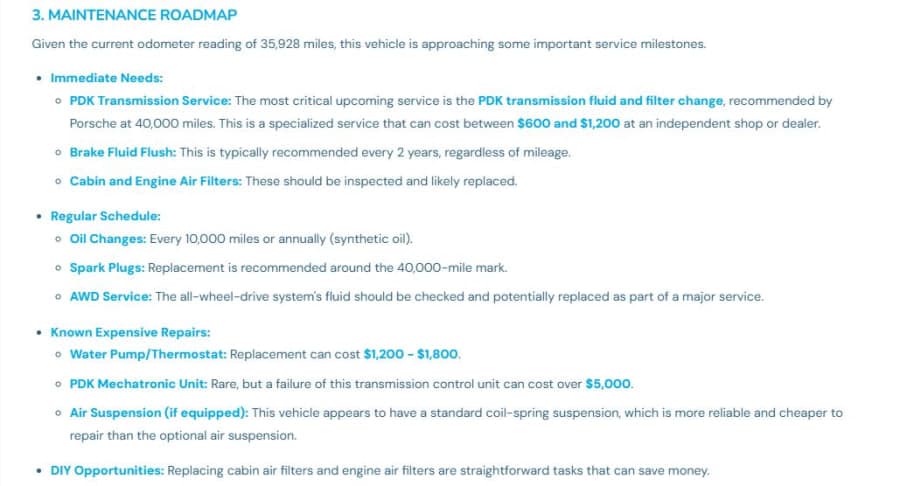
What maintenance is this car due for next, based on its mileage?
Based on the recorded mileage and age, the AI lays out the maintenance that's coming due — handy for budgeting before you buy.
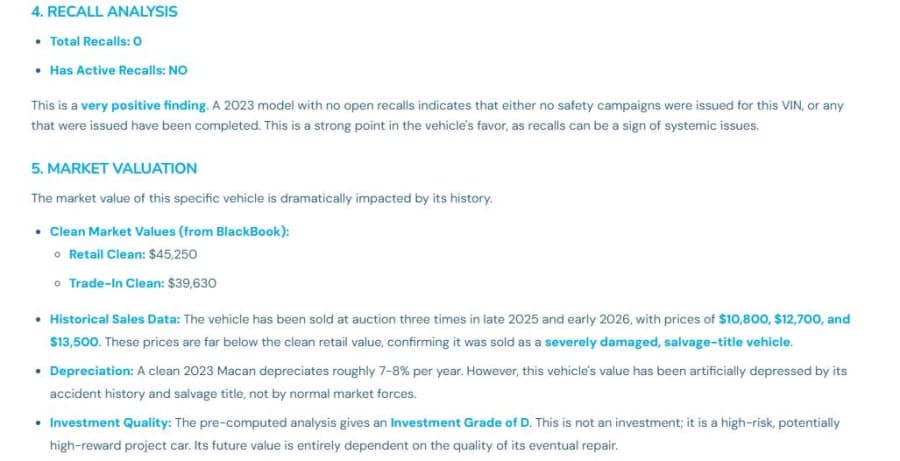
How do open recalls affect what this car is actually worth?
The AI weighs open NHTSA recalls against current market value, so you understand how unresolved recalls could affect price and safety.
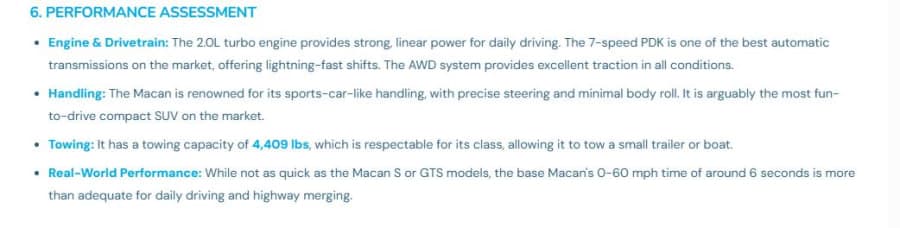
How does this car's recorded history affect how it drives today?
The AI connects accident severity, mileage, and maintenance gaps to flag anything that could affect performance or reliability now.
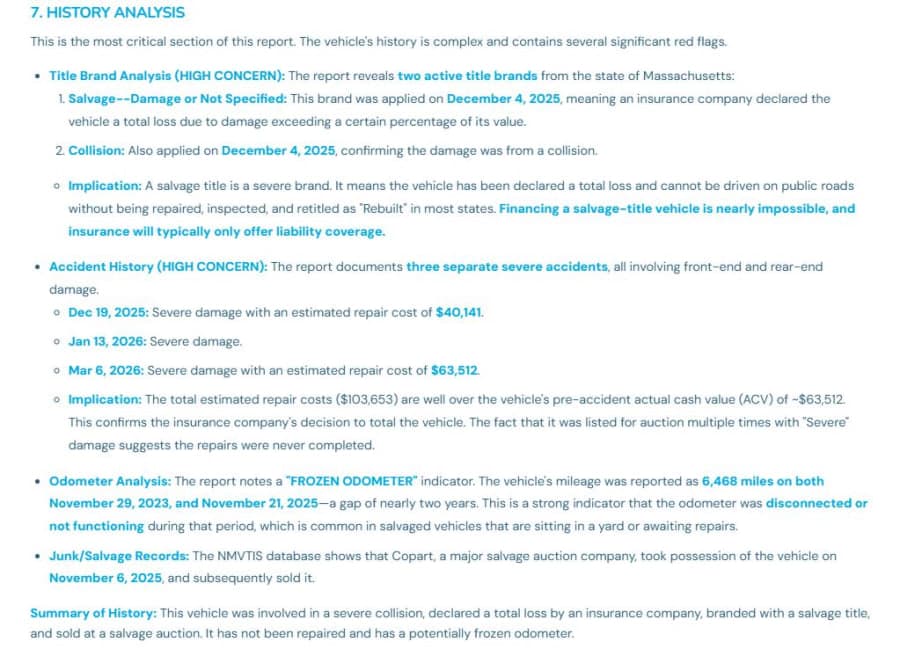
What pattern does the AI see across this car's full history?
Instead of a wall of records, the AI connects the dots across ownership, accidents, and title changes to explain what really happened to this car.
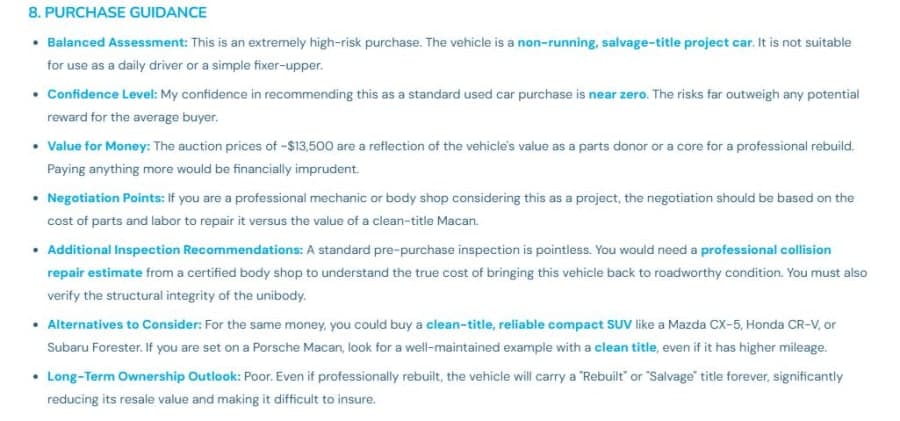
Should I buy this car — and what should I offer?
Based on everything in the report, the AI gives you a clear buy or avoid recommendation and a suggested price range to negotiate from.
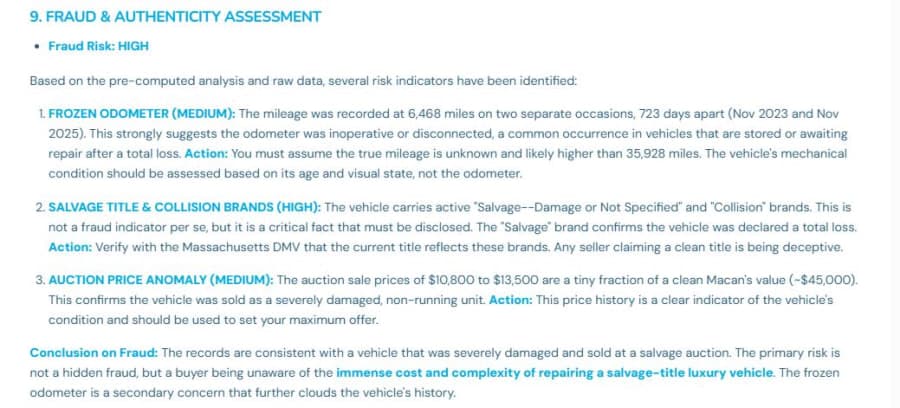
How confident can I be that this VIN matches this exact car?
A deeper authenticity check confirms the VIN, specs, and records all match up — an extra layer of confidence before you commit.
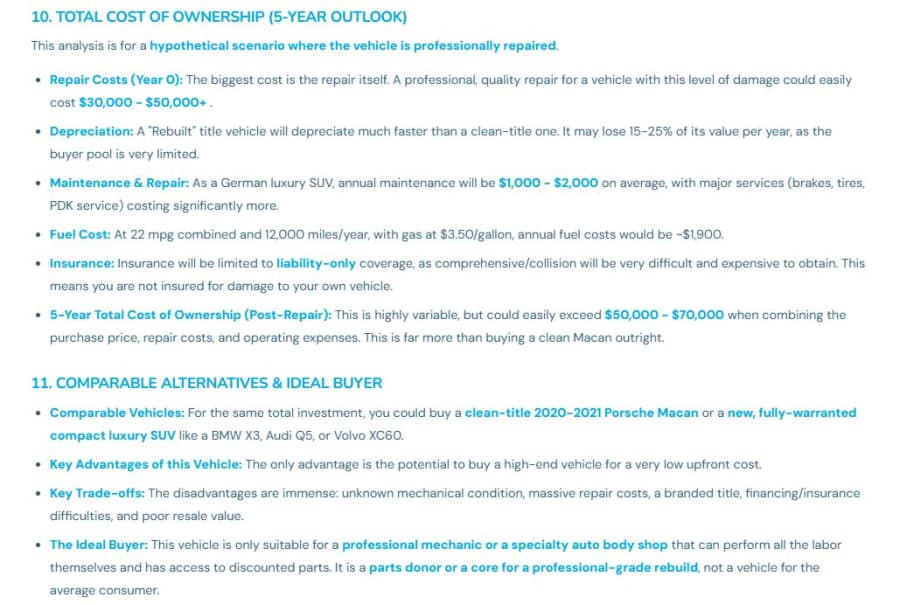
What will it really cost to own this car over the next few years?
The AI estimates fuel, insurance, maintenance, and depreciation together, so you can budget for the true cost — not just the sticker price.
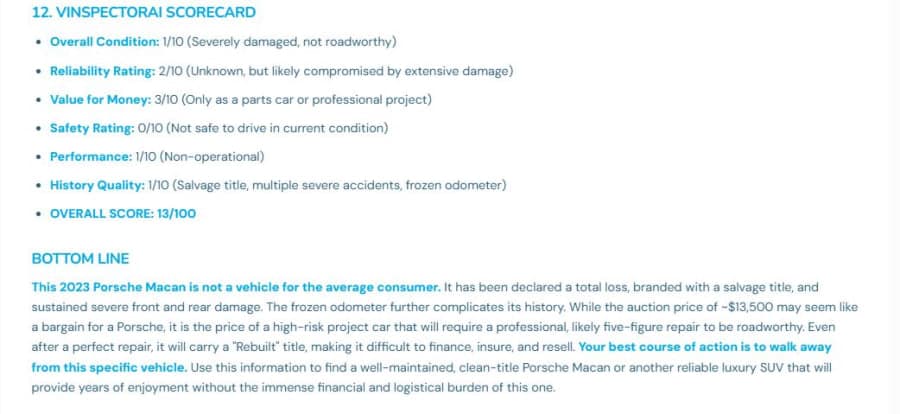
What's the AI's final verdict — and how did it get there?
Every signal from the report — accidents, title, value, recalls — rolls up into one final assessment with the reasoning spelled out.
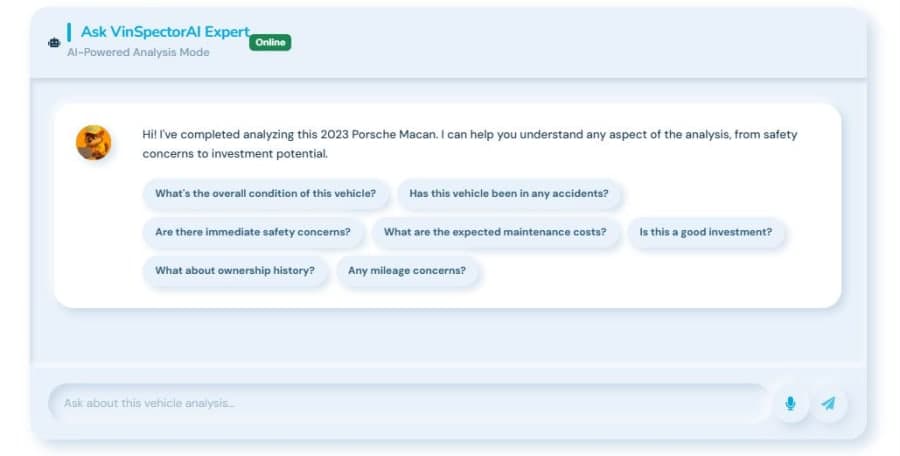
Can I just ask the AI my own questions about this car?
Chat with the AI about this exact vehicle — ask about negotiation, repair costs, or anything else in the report, in plain English.
Why Hawaii buyers choose VinSpectorAI
Storm Damage Verification • Coastal Flood Records • Volcanic Exposure Checks
Buying a used car in Hawaii? Free VIN checks won't tell you about storm damage from Lane or Olivia, saltwater corrosion from coastal parking, or whether that Big Island truck sat through volcanic ash fallout. Those problems cost thousands to fix—and they're way more common here than on the mainland. Our AI-powered reports dig deep into Hawaii-specific data, giving you the full picture before you buy. View our pricing plans to see how we compare.
One Price, No Subscriptions
Pay $12.95 once and you're done. Your report stays accessible for 30 days with unlimited downloads—no auto-renewals or hidden charges.
Get Results in Under a Minute
Type in your VIN, hit search, download your PDF. Works from your phone while you're at the dealership or checking out a Craigslist car.
Hawaii-Specific Damage Databases
We search storm archives, coastal flood records, volcanic activity logs, and military auction histories—data sources mainland VIN services don't even know exist.
AI Flags Suspicious Patterns
Our system spots red flags like a car registered in Puna right before the 2018 lava flow, or one that changed islands immediately after a major storm hit.
Island Vehicle Risk Checks
Salt air corrosion from beach parking, lava zone exposure, storm surge damage, inter-island shipping problems—we check for issues that only matter in Hawaii.
Your Data Stays Private
SSL encryption and PCI-compliant payment processing. We don't sell your search history or spam you with emails.
Frequently asked questions about Hawaii VIN checks
Can't find what you're looking for? Visit our complete FAQ page or contact us directly.
Make an informed decision — get your Hawaii vehicle report
Don't buy a car with hidden storm damage, coastal flooding, or volcanic ash exposure. Get your Hawaii VIN check now and see what you're really buying.
VinSpector AI provides Hawaii residents with vehicle history data from NMVTIS, Hawaii DMV records, NHTSA, and insurance databases to verify title status and vehicle condition.