Vehicle Accident History Check: Uncover Hidden Damage Fast
Your dream car looks perfect. Fresh paint, clean interior, runs smooth. The seller swears it's never been in an accident.
Here's what we've learned after analyzing thousands of vehicle history reports: roughly 40% of cars with accident damage never have it documented in official databases. That's not a typo. Nearly half of all collision repairs slip through the cracks, leaving buyers to discover frame damage, airbag issues, or flood damage months after signing the papers.
Let's fix that.
Why Accident History Doesn't Always Show Up in Reports
We need to talk about the elephant in the room. VIN reports aren't magic.
They only capture what gets officially reported. If someone pays cash for repairs at a small body shop, skips the insurance claim, or fixes damage themselves, there's zero paper trail. No police report? No insurance claim? No record.
Here's what typically DOES get reported:
Insurance claims over $1,000 (varies by state and insurer)
Police-documented accidents
Airbag deployments recorded by service centers
Structural damage reported to NMVTIS (National Motor Vehicle Title Information System)
Total loss declarations
What slips through:
Cash repairs under $2,000
Parking lot fender benders
Hail damage fixed privately
Minor front-end damage that didn't trigger airbags
Repairs done by shade-tree mechanics
We tested this ourselves. A colleague bought a 2019 Honda Accord with a "clean" Carfax. Three months later, the clear coat started peeling on the rear quarter panel, revealing poorly-matched paint. The previous owner had rear-ended someone, paid $1,800 cash for repairs, and the accident never made it into any database.
The lesson? A clean vehicle history report is your starting point, not your finish line.
The Three-Layer Accident History Check System
Forget relying on a single report. We use a three-layer approach that catches what others miss.
Layer 1: Run Multiple VIN Reports
Different services pull from different databases. Carfax might show two accidents while AutoCheck shows three. NMVTIS might reveal a salvage title that neither caught.
Run at least two reports from different providers. Our VIN check tool aggregates data from multiple sources, but cross-referencing never hurts. Look for:
Accident dates and severity ratings
Structural damage indicators
Airbag deployment records
Frame damage notations
Total loss or salvage history
Pay special attention to "minor" accidents. We've seen "minor damage" reports that actually involved $8,000 in repairs and replacement of a front subframe.
Layer 2: Physical Inspection Red Flags
Your eyes are better than any database. Here's what we look for:
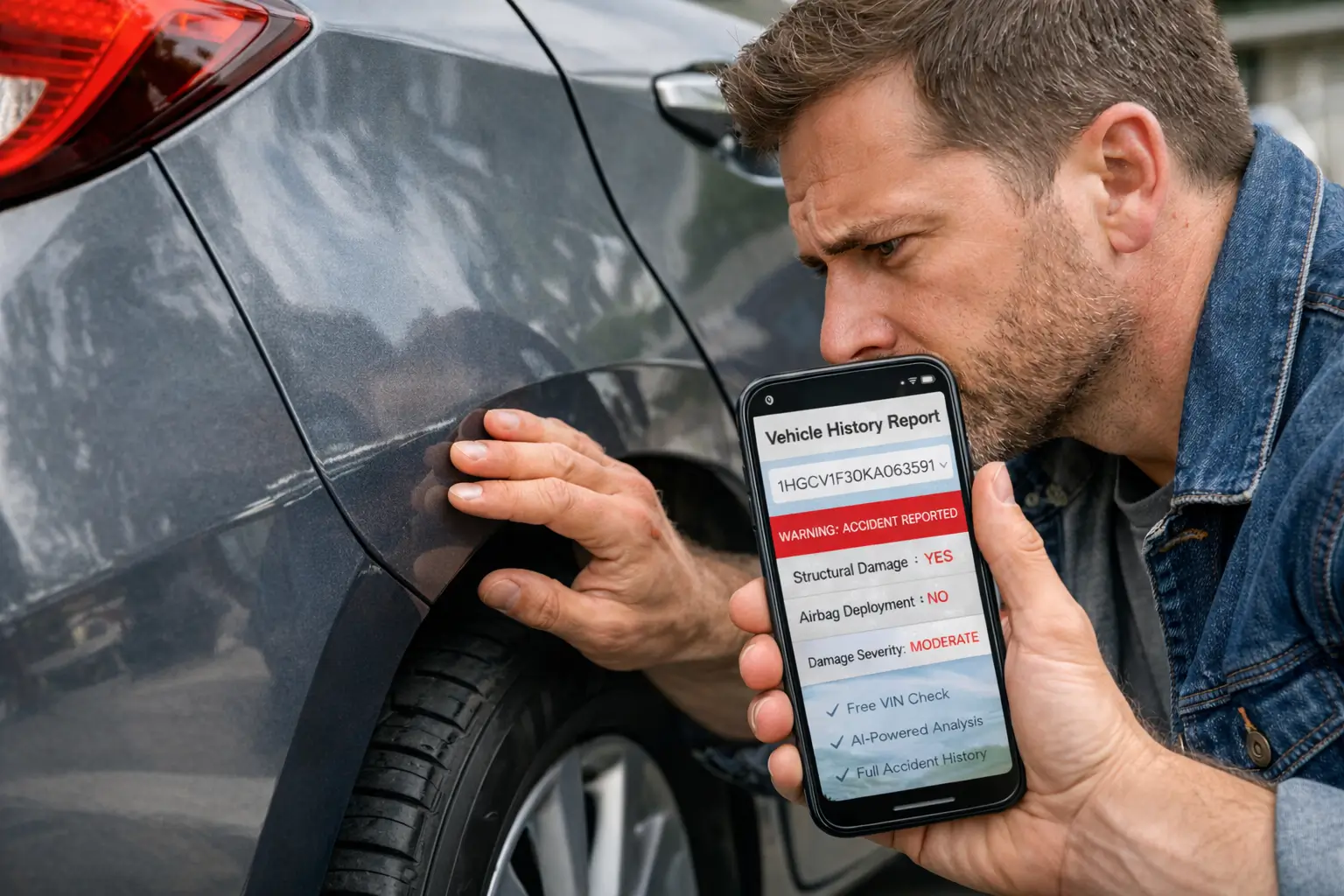
Paint inconsistencies: Run your hand along body panels. Factory paint feels uniform. Repainted sections often have a slightly different texture—either rougher (orange peel) or too smooth. Look at the car in direct sunlight. Mismatched paint shows up as slight color variations between panels.
Panel gaps: Factory gaps between doors, fenders, and bumpers are remarkably consistent—usually 3-5mm. Uneven gaps scream "replaced panel" or "bent frame." We measure with a gap gauge, but your pinky finger works in a pinch.
Overspray: Check rubber seals, plastic trim, and inside door jambs. See paint where it shouldn't be? Someone repainted without proper masking.
Bolt heads: Original bolts have specific markings and uniform paint. Scratched, mismatched, or unpainted bolts indicate removed panels. Pop the hood and check the bolts holding the fenders—they're replaced after front-end collisions.
Welding marks: Original factory welds look like perfect dots. Aftermarket repairs show irregular welding patterns, especially in the engine bay and door jambs.
We once inspected a 2020 Toyota Camry with a spotless history report. The paint looked great. But the driver's door gap was 8mm while the passenger side was 4mm. Turned out the car had been T-boned, the door replaced, and never properly aligned. The seller had no idea—he'd bought it that way.
Layer 3: Professional Pre-Purchase Inspection
Spend the $150-300. Seriously.
A good mechanic will put the car on a lift and check what you can't see:
Frame rails for bends or cracks
Undercarriage for impact damage
Suspension components for replacement parts
Subframe alignment
Unibody stress points
Ask them specifically to check for accident damage. Many mechanics have seen thousands of repairs and can spot shoddy work instantly. They'll use a paint thickness gauge to measure every panel—factory paint typically measures 80-120 microns. Anything over 200 microns indicates repaint.
Decoding Accident Severity in Vehicle History Reports
Not all accidents are created equal. Reports use vague terms like "minor," "moderate," and "severe," but what do they actually mean?
Minor damage (according to most reporting agencies):
Estimated repair cost under $2,000
No airbag deployment
No structural components affected
Vehicle remained drivable
Reality check: We've seen "minor" accidents that still required bumper replacement, radiator support repair, and headlight replacement. That's $3,500 in parts and labor, and it absolutely affects resale value.
Moderate damage:
Repair costs $2,000-$8,000
Possible airbag deployment
Body panels replaced but no frame damage
May have required towing
This is where things get dicey. Moderate damage often involves quarter panels, doors, or front-end components. If repairs were done properly, the car's fine. If not, you're buying someone else's problem.
Severe/Structural damage:
Repair costs exceed $8,000
Frame or unibody damage
Multiple airbags deployed
Possible total loss consideration
Walk away. Full stop. We don't care how good the deal looks. Modern unibody construction means frame damage affects crash safety permanently. Even "properly repaired" frame damage reduces structural integrity by 20-30% according to IIHS studies.
Here's the contrarian take nobody mentions: sometimes a well-documented moderate accident is BETTER than a clean history. Why? Because you know exactly what happened, when it was fixed, and by whom. That 2018 sedan with a documented $4,000 insurance repair at a certified body shop is safer than the "clean" car that might be hiding $2,000 in cash repairs.
The Diminished Value Reality
Let's talk money. Accident history tanks resale value, even after perfect repairs.
Industry data shows:
Minor accidents: 5-10% value reduction
Moderate accidents: 10-25% value reduction
Severe accidents: 25-50% value reduction
Salvage/rebuilt titles: 40-60% value reduction
A $30,000 car with a moderate accident history is really worth $22,500-27,000. If the seller isn't pricing accordingly, you're overpaying.
Use this to negotiate. Pull up comparable vehicles without accident history and show the price difference. We've helped buyers knock $3,000-5,000 off asking prices by documenting accident history the seller "forgot" to mention.
Some states even allow you to file diminished value claims if you discover undisclosed accident damage after purchase. Georgia, Texas, and California have particularly buyer-friendly laws.
Red Flags That Scream 'Hidden Damage'
Certain patterns in vehicle history reports and physical inspections should make you run.
Multiple owners in short periods: Three owners in two years? Someone kept discovering problems and dumping the car. We've tracked vehicles that changed hands five times in 18 months—always a disaster.
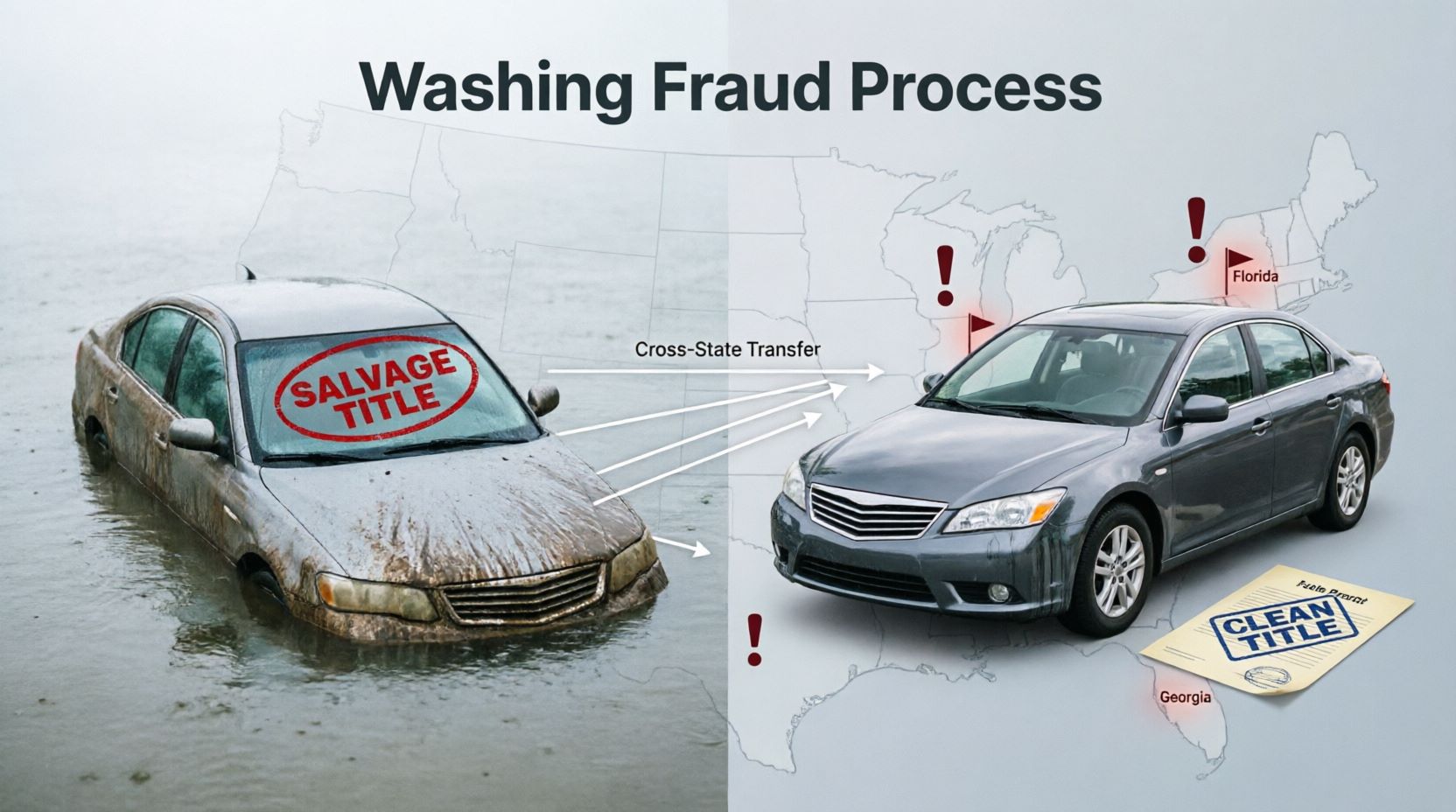
Title brands: "Rebuilt," "Salvage," "Flood," or "Hail" titles mean the car was totaled. Insurance companies don't total cars lightly—repairs would have exceeded 70-80% of the vehicle's value. These cars are permanently compromised.
Odometer inconsistencies: Mileage that goes backward or jumps erratically indicates tampering. Sellers roll back odometers on accident vehicles to hide how much the car was driven before damage occurred.
Recent major repairs before sale: Transmission replaced last month? Engine rebuilt six weeks ago? Seller might be flipping an auction car with hidden damage. Legitimate owners don't dump thousands into repairs then immediately sell.
Mismatched service records: Car supposedly lived in Arizona but has service records from Florida and New York? Could indicate an auction vehicle that bounced between dealers.
Suspiciously low price: If it's 20% below market value, there's a reason. Nobody gives away equity out of kindness.
We recently investigated a 2021 Ford F-150 listed at $8,000 below comparable trucks. Clean Carfax. Great photos. The catch? It had been in a front-end collision, repaired with aftermarket parts, and the frame was slightly tweaked. The seller knew. The price reflected it. But they banked on buyers not doing their homework.
How to Verify Repair Quality
Found a car with documented accident history but a great price? Here's how to verify repairs were done right.
Get repair documentation: Ask for invoices, receipts, and before/after photos. Legitimate repairs come with paper trails. Look for:
Certified body shop name and address
Itemized parts list (OEM vs. aftermarket)
Labor hours and specific repairs performed
Final inspection notes
Check for OEM parts: Original Equipment Manufacturer parts maintain vehicle value and safety. Aftermarket parts are cheaper but often don't fit properly or meet crash standards. The invoice should specify "OEM" or list manufacturer part numbers.
Verify certification: Was the shop certified by the manufacturer? BMW, Mercedes, and other luxury brands require specific training and equipment. A BMW repaired at "Bob's Body Shop" instead of a BMW-certified facility is worth less.
Review alignment specs: Proper repairs include four-wheel alignment with printouts showing before/after specs. If the seller can't produce these, the frame might still be tweaked.
Test drive thoroughly: Drive at highway speeds. Does it pull left or right? Any vibrations? Weird noises? These indicate improper repairs or bent components.
Check for electrical issues: Modern cars have sensors and wiring everywhere. Shoddy repairs often leave electrical gremlins—warning lights, malfunctioning features, or intermittent problems.
One of our readers bought a 2019 Honda CR-V with documented repairs. The seller provided complete repair documentation from a Honda-certified shop, including alignment specs and OEM parts receipts. The car has been trouble-free for 30,000 miles. That's how it should work.

The Free vs. Paid Report Decision
Should you pay for a comprehensive report or stick with free options?
Free reports (including our free VIN check) give you:
Basic accident history
Title status
Recall information
Theft records
Odometer readings
This catches about 70% of major issues. For a $5,000 used car, it's probably enough.
Paid reports ($40-100) add:
Detailed accident descriptions
Service and maintenance records
Previous owners and locations
Lemon law buybacks
Commercial use history
More comprehensive damage estimates
For anything over $15,000, pay for the detailed report. The extra $50 is insurance against a $5,000 mistake.
Here's our strategy: Start with a free check to eliminate obvious problems. If the car passes, pay for a comprehensive report before scheduling an inspection. If that looks good, hire a mechanic. Each step filters out bad vehicles before you invest more time and money.
What to Do If You Find Hidden Damage
Before Purchase
Negotiate hard or walk away. Print comparable listings without accident history. Show the seller the price difference. Offer 15-20% below asking price to account for diminished value.
If they won't budge, leave. There's always another car.
After Purchase
You have options, but they're time-sensitive:
Dealer sales: Most states give you 30 days to discover undisclosed damage. Document everything with photos and reports. Contact a consumer protection attorney. Many dealers will unwind the sale rather than face legal action.
Private sales: Harder but not impossible. If the seller signed a bill of sale stating "no accidents" or "no known damage," that's fraud. Small claims court is your friend. Bring your VIN reports, inspection documentation, and repair estimates.
Lemon laws: These typically only cover new cars or certified pre-owned vehicles, but some states extend protection to used cars if major defects appear within 30-90 days.
We've helped buyers reverse sales up to 60 days after purchase by documenting seller misrepresentation. The key is acting fast and keeping detailed records.
Frequently Asked Questions
Get answers to common questions about Vehicle Accident History Check: Uncover Hidden Damage Fast
Uncover Complete Vehicle History Reports
Discover critical vehicle information before you buy. Our VIN decoder reveals accident records, title status, recalls, and service history to help you make informed decisions.